
World Food Programme
At the 30th United Nations Climate Change Conference (COP30), African Development Bank (AfDB), development partners call for major new financing to accelerate Africa’s Great...
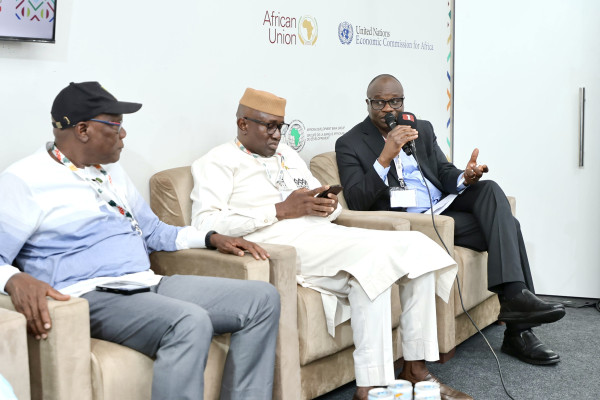
At the 30th United Nations Climate Change Conference (COP30) in Belém, Brazil, development partners including the African Development Bank (www.AfDB.org), urged for a scale up in financing to deliver the Great Green Wall's 2030 targets.
Currently funded by contributions from Member States and development partners, this African Union initiative aims to restore 100 million hectares of degraded land, sequester 250 million tonnes of carbon and create 10 million jobs in 11 countries in the Sahel region, stretching from Senegal in the west to Djibouti in the east of the continent.
“Despite the support of many countries and institutions, including multilateral development banks such as the African Development Bank and the World Bank, we are still far from meeting the financing needs of the Great Green Wall,” said Ibrahim Sow, special advisor to the Senegalese president on environmental issues.
Sow moderated a session during the climate conference titled ‘Scaling up finance for the Great Green Wall: from climate ambition to integrated action for Land, Nature and People'. The session was organised by the Pan-African Agency for the Great Green Wall, the African Development Bank Group and the World Food Programme, as a forum to discuss strategies for mobilising large-scale financing, including private and innovative resources. The Pan-African Agency for the Great Green Wall, based in Nouakchott, is the implementing body for the Great Green Wall Initiative.
In January 2021, €19 billion in contributions were announced for the Great Green Wall during a round table organised in Paris alongside the One Planet Summit on biodiversity. The African Development Bank, a leading partner in the initiative, indicated that it would contribute approximately $6.5 billion through its ongoing programmes.
“Fifteen years after its launch, the Great Green Wall is moving from vision to implementation. Millions of hectares have been restored, and thousands of green jobs have been created, but significant gaps in financing and capacity remain. To achieve its goals by 2030, enhanced collaboration between African governments, development partners and the private sector is essential,” argued Mr Garba, a former Minister of the Environment for Niger.
Sékou Koné, technical advisor to the Malian Ministry of the Environment, representing its minister, believed that political will, the development of a legal framework to protect investments in the Great Green Wall area and an attractive economic environment would encourage other partners and the private sector to invest. “Our countries must position themselves to access new funds. One example is the Tropical Forest Forever Facility (TFFF), which has just been launched by the Brazilian presidency of COP 30, to which 74 countries have said they will sign up,” he said, echoing support for South-South cooperation.
Participants stressed the importance of strengthening institutional capacities, human resources and the very structure of the agency, to ensure it has all the resources it needs to operate effectively.
Al-Hamndou Dorsouma, the African Development Bank's manager for Climate and Green Growth, affirmed the institution's very strong' support for the Great Green Wall.
“In addition to attracting concessional public resources, the Agency should develop a pipeline of bankable projects in land restoration and climate change adaptation, with a view to mobilising new and innovative financing, including blended finance, carbon markets, green bonds and climate funds, in order to bridge the Great Green Wall's financing gap,” Doursouma said.
He cited as an example the Climate Action Window created as part of the 16th replenishment of the African Development Fund (ADF-16) in 2023, which mobilised more than $450 million, enabling it to support 41 projects worth $322 million in its first year of operation, with beneficiaries including countries in the Great Green Wall. He called for enhanced coordination and synergy of action among the partners of the initiative to avoid duplication of actions.
Participants in the session emphasised the need for close involvement of local communities and local authorities, as well as strengthening national structures to enable them to access climate finance directly.
Distributed by APO Group on behalf of African Development Bank Group (AfDB).Sudan: United Nations (UN) chief condemns deadly strikes on children’s nursery, hospital
Download logo
As Sudan's civil war intensified on Monday, top UN officials condemned the killing of dozens of children in drone strikes in South Kordofan state – and the targeting of first responders trying to help the wounded.
In a statement issued by his Spokesperson, UN Secretary-General António Guterres said that he was appalled to learn that multiple drone strikes on 4 December had hit a children's nursery and a hospital in Kalogi, where the injured were being treated.
Echoing those concerns, the head of UN World Health Organization, Tedros Adhanom Ghebreyesus, said that Kalogi Rural Hospital had been targeted at least three times, killing 114 people including 63 children.
Blood bank call
Survivors from those strikes have been moved to Abu Jebaiha Hospital in South Kordofan for treatment “and urgent calls are being made for blood donations and other medical support”, Tedros noted in a statement posted on X.
“Disturbingly, paramedics and responders came under attack as they tried to move the injured from the kindergarten to the hospital,” Tedros added.
On the same day as those attacks, an aid convoy was also targeted in North Kordofan state. It had been transporting lifesaving supplies to North Darfur when it came under fire, seriously injuring the driver of a UN World Food Programme (WFP) truck.
“The Secretary-General deplores this further attack on humanitarian operations at a time of dire needs,” the statement continued.
Suffering on a huge scale
Aid agencies warn that the situation across Sudan remains catastrophic for millions of people caught up in heavy fighting between the Sudanese Armed Forces (SAF) and the paramilitary Rapid Support Forces (RSF).
In the central Kordofan region in particular, dire conditions are worsening still as life-saving supplies run low, while famine conditions have been confirmed in South Kordofan's state capital, Kadugli.
“As fighting intensifies, the horrific human rights violations and abuses reported in El Fasher in recent months, as well as reports of serious violations of international humanitarian law, must not be repeated in the Kordofan region,” the UN chief's Spokesperson insisted.
And amid reports of continued foreign involvement in the Sudan conflict, “the Secretary-General calls on all States with influence over the parties to take immediate action and use their leverage to compel an immediate halt to the fighting and stop the arms flows” that are fuelling it, his Spokesperson's statement added.
“The Secretary-General renews his call on the parties to agree on an immediate cessation of hostilities and to resume talks to reach a lasting ceasefire and a comprehensive, inclusive and Sudanese-owned political process. The United Nations stands ready to support genuine steps to end the fighting in Sudan and chart a path towards a durable peace.”
UN rights chief's plea
The development comes after the UN's human rights chief, Volker Türk, said that he feared “another wave of atrocities” in Sudan.
Since late October, hundreds of civilians have been killed and tens of thousands more have fled aerial strikes, shelling and summary executions, he said, amid mass civilian displacement involving more than 45,000 people fleeing violence and seeking safety in or near to Kordofan region.
“Safe passage for those fleeing the horror of famine, death and destruction is essential and a human rights imperative,” the High Commissioner's office said.
In an appeal for “urgent diplomatic action” the WFP's Deputy Executive Director Carl Skau insisted that greater attention was needed to prevent further atrocities and help reverse famine.
More than 30 million people in Sudan now need humanitarian assistance and more than nine million have been displaced inside the country since fighting erupted in April 2023 between the SAF and paramilitary RSF.
Distributed by APO Group on behalf of UN News.