
Explore more Articles in
Resource
Shaping Africa’s Mining Future: Community Engagement, Local Content, Skills Transfer and Shared Infrastructure at African Mining Week (AMW) 2026
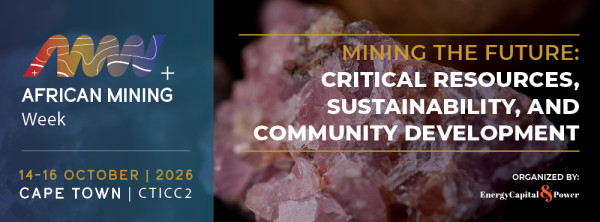

The 2026 edition of African Mining Week (AMW) – officially launched last week – will bring together global mining companies, investors, policymakers and industry stakeholders to explore emerging opportunities across Africa's minerals sector. The event will examine how Africa – the world's largest producer of key energy-transition metals including platinum group metals, cobalt, chromium and manganese – is shaping global supply chains and attracting increasing investment from markets such as the U.S., China and Europe.
AMW 2026 will take place under the theme, “Mining the Future: Critical Resources, Sustainability, and Community Development,” aiming to showcase Africa's strategic role in the global critical minerals market, highlight innovative approaches to sustainable and responsible mining and foster collaboration between governments and industry. Building on the success of the 2025 edition, the event will provide a platform to discuss sustainable market growth, environmental stewardship and socioeconomic development across the continent.
Panels and discussions will highlight Africa's role as a global hub for critical energy-transition minerals, with countries such as Zimbabwe, Mali, Namibia and Malawi advancing local value-addition mandates and strategically managing raw mineral exports to maximize domestic economic benefits. AMW 2026 will explore opportunities across the continent's critical minerals sector, from mining and exploration to processing and industrialization, providing insights into how investors and governments can collaborate to strengthen supply chains and unlock the full potential of Africa's mineral wealth.
Environmental stewardship and responsible mining practices will also be a core focus. Financiers including the Africa Finance Corporation, World Bank, IFC and Afreximbank increasingly tie funding to ESG performance, and panels will examine how renewable energy solutions – from Power Purchase Agreements and Independent Power Producer arrangements to energy wheeling and onsite generation – can reduce emissions, improve energy security and enhance project bankability. The event will also highlight innovative strategies for sustainable resource development that balance commercial returns with ecological and social responsibility.
Community engagement, local content, skills transfer and shared infrastructure remain central to Africa's mining policies. AMW 2026 will showcase projects that deliver tangible socioeconomic benefits, from job creation and supplier development to gender empowerment and improved community infrastructure. Discussions will also unpack tax regimes, community-benefit frameworks and ESG obligations that shape project implementation, emphasizing how mining can serve as a catalyst for inclusive growth across the continent.
"African Mining Week 2026 will be a showcase of Africa's potential to power the future," states Rachelle Kasongo, Events & Project Director at Energy Capital & Power. "The event will highlight how the continent's critical resources can be responsibly developed, how innovative practices are shaping a more sustainable mining sector and how investments can create meaningful benefits for local communities. It's a space for leaders to exchange ideas, forge partnerships and explore solutions that drive long-term impact for both industry and society."
African Mining Week serves as a premier platform for exploring the full spectrum of mining opportunities across Africa. The event is held alongside the African Energy Week: Invest in African Energies 2026 conference from October 12-16 in Cape Town. Sponsors, exhibitors and delegates can learn more by contacting sales@energycapitalpower.com.
Distributed by APO Group on behalf of Energy Capital & Power.Egypt: Her Excellency (H.E.) Dr. Rania Al-Mashat, Minister of Planning, Economic Development and International Cooperation, Meets Military Attachés Designated for Overseas Assignments
Download logo
- Integrated coordination across government policies to stimulate investment, boost production, and empower the private sector.
- Growth expected to exceed 5% in the current fiscal year, with efforts underway to reach 7% to increase employment and deliver citizen-centered development.
- International institution reports confirm the success of government measures in enhancing economic stability and overcoming multiple challenges.
- Completion of the fifth and sixth IMF reviews and the continuation of reforms reinforce positive economic prospects for 2026.
- The government continues to implement incentives that strengthen the contribution of production, exports, investment, and industry to economic growth.
- Public investment governance successfully enforced in FY 2024/2025, adhering to the EGP 1 trillion ceiling to enable private sector expansion.
- Completion of 11 high-level and ministerial joint committees in 2025 with brotherly and friendly countries, and the signing of more than 65 cooperation agreements and protocols.
- Unified horizontal objectives and clear performance indicators across all ministries to ensure coordinated efforts and the achievement of ambitious growth, employment, and export targets.
- Macroeconomic stability and reform are mutually reinforcing paths—reforms enhance stability, and stability enables reform, laying solid foundations for sustainable economic development.
H.E. Dr. Rania Al-Mashat, Minister of Planning, Economic Development and International Cooperation, met with military attachés designated for overseas postings.
During the meeting, H.E. Dr. Al-Mashat noted that Egypt's economic growth rates have risen steadily since July 2024, explaining that growth is primarily driven by productive sectors—namely industry, tourism, and information and communications technology—sectors largely led by the private sector. She emphasized that 98% of the tourism sector is private, as is the industrial sector, including automotive manufacturing, chemicals, textiles and garments, household appliances, and broader manufacturing activities, reaffirming that Egypt's economy is driven by productive, private-sector-led sectors.
She explained that industrial production growth has translated into a significant increase in Egyptian exports. In tourism, Egypt is expected to approach nearly 19 million tourists this year, while tourism nights in the last quarter of the previous fiscal year reached record levels. She added that Suez Canal activity recorded positive performance in the quarter ending September and is recovering amid peace efforts sponsored by H.E. President Abdel Fattah El-Sisi and U.S. President Donald Trump. Despite Egypt being among the countries most affected by regional developments due to declining Suez Canal revenues, the economy has recovered and its indicators have improved. She noted that the Suez Canal accounts for around 12% of global trade, and any disruption has global inflationary implications.
H.E. Dr. Al-Mashat stressed that economic growth followed critical reforms implemented in March 2024, alongside measures to govern public investment and impose a fixed investment spending ceiling of EGP 1 trillion in the budget to create space for private sector expansion. This led to an increase in the private sector's share of total investment, with private enterprises now receiving the largest share of bank credit, particularly in the industrial sector.
She projected that Egypt's economy will achieve growth approaching 5% in the current fiscal year, supported by continued economic and structural reforms, with the government aiming to reach growth rates of 7% to boost employment and ensure development outcomes that positively impact citizens. She highlighted that international institution reports confirm the effectiveness of government measures in strengthening economic stability and overcoming challenges.
H.E. Dr. Al-Mashat affirmed that 2026 will represent a pivotal turning point for the Egyptian economy following fiscal and monetary reforms, the continuation of structural reforms, and efforts to open new economic horizons. The emerging economic model builds on infrastructure investments—particularly in ports and logistics zones—while focusing on higher-productivity sectors. She emphasized that Egypt's policy framework prioritizes industry, tourism, technology, and construction, noting that such reforms cannot be implemented without macroeconomic stability.
She highlighted the role of productive sectors in job creation, stressing that reforms drive employment through private-sector-led growth, particularly in industry, tourism, and ICT. She added that the completion of the fifth and sixth IMF reviews, alongside sustained reform policies, will further strengthen positive economic trends in 2026.
H.E. Dr. Al-Mashat underscored Egypt's Narrative for Economic Development: Reforms for Growth, Jobs & Resilience, which guides the transition toward a higher-productivity economic model.
She noted that the second edition includes a dedicated human development pillar, reaffirming that macroeconomic stability is a cornerstone of development through predictable fiscal and monetary policies, public investment governance, fiscal discipline, and domestic resource mobilization. Structural reforms, she added, reinforce macroeconomic stability, support the green transition, and unlock economic growth channels.
She explained that the national structural reform program follows a defined timeline and is implemented under the Ministry's supervision in coordination with more than 40 national entities. The program includes over 430 measures across sectors such as tax and trade reforms, public investment governance, social protection, private sector participation, labor market reforms, electricity and renewable energy, innovation and startups, and industrial competitiveness.
H.E. Dr. Al-Mashat further noted that the Ministry continues to strengthen partnerships with international institutions, UN organizations, and the private sector to mobilize resources and advance development finance solutions. Egypt's strong international relations, implementation capacity, and effective project design enhance access to concessional financing—lower-cost alternatives to market borrowing—without increasing debt burdens or shortening maturities.
In this context, she highlighted that concessional financing for budget support for 2023–2026 amounts to USD 9.5 billion, while the private sector has received USD 17 billion since 2020. Renewable energy was underscored as a critical alternative to reduce gas and fuel oil imports, with the government targeting 42% renewable energy by 2030.
She noted that through the NWFE Country Platform (Nexus of Water, Food and Energy), approximately USD 5 billion in concessional development financing has been mobilized for domestic and foreign private sector entities to implement renewable energy projects and support investments in the national electricity grid.
H.E. Dr. Al-Mashat emphasized that human development is a core pillar of economic development, with investment in human capital representing a direct investment in a more productive and equitable future. She noted that citizens are the (center of development), adding that 48% of public investments in the FY 2025/2026 plan are directed toward human development sectors.
She explained that the medium-term development plan, prepared in accordance with the State Planning Law, will be developed using the programs-and-performance methodology and will include shared horizontal objectives and clear performance indicators across ministries to ensure unified efforts and the achievement of ambitious targets for growth, employment, and exports.
Finally, H.E. Dr. Al-Mashat highlighted the importance of high-level and ministerial joint committees overseen by the Ministry, describing them as a key mechanism for strengthening Egypt's economic, trade, and investment relations, as well as cultural, scientific, and technical cooperation with partner countries. The Ministry oversees around 55 joint committees with countries across the globe. In 2025 alone, Egypt completed 11 high-level and ministerial committees and signed more than 65 cooperation agreements and protocols to enhance trade and investment relations.
Distributed by APO Group on behalf of Ministry of Planning, Economic Development, and International Cooperation - Egypt.A Significant Step in Pediatric Surgery in Tunisia: A Pediatric Recovery Room Established in Monastir
Download logo
Fatouma Bourguiba University Hospital, located in the city of Monastir, is a major healthcare center nationwide with its Pediatric Surgery Department performing surgical interventions on approximately 4,000 children annually.
Serving not only patients from Monastir but also pediatric patients from different regions of Tunisia, the hospital previously faced a serious risk due to the absence of a pediatric recovery room where children could be safely monitored after surgery.
In response to this need, a pediatric recovery room meeting international standards was established within the framework of a request submitted by the hospital. The newly established unit has been equipped with pediatric ventilators, multi-parameter monitors, infusion pumps, child-specific resuscitation beds, and the necessary anesthesia equipment.
Through this project, which is expected to directly benefit at least 1,000 children annually, it is aimed to enhance the safety of critically ill pediatric patients and minimize the risks of complications and mortality. The project also includes training programs for healthcare personnel on post-operative pediatric monitoring and emergency intervention protocols, thereby strengthening human resource capacity.
Through this project that directly touches the lives of pediatric patients, TİKA continues to strengthen Tunisia's healthcare infrastructure.
Distributed by APO Group on behalf of Turkish Cooperation and Coordination Agency (TIKA).