
Explore more Articles in
Industrial
Italy-Libya Roundtable at Libya Energy & Economic Summit (LEES) 2026 to Drive Strategic Energy and Infrastructure Investment

Download logo
The Libya Energy & Economic Summit (LEES) 2026, taking place January 24–26 in Tripoli, will host a dedicated Italy-Libya Roundtable, underscoring Italy's long-standing and expanding engagement in Libya's energy, infrastructure and broader economic sectors. The session will provide a platform to explore strategic partnerships, investment pipelines and joint initiatives that strengthen Libya's energy security and infrastructure resilience – and cement Italy's role as a key partner in the country's long-term development.
Italian companies are already deeply involved across Libya's energy sector. Last month, Eni resumed exploration after a five-year hiatus, restarting drilling at the C1-16/4 well in Block 16/4 using Saipem's Scarabeo-9 rig. Through its 50-50 joint venture with the NOC, Mellitah Oil & Gas, Eni is advancing an €8 billion integrated gas development project targeting production from Structures A&E, expected to deliver 750 million cubic feet per day by 2026.
Italian geoscience and offshore construction firm Next Geosolutions and its subsidiary Rana Subsea were awarded €8.5 million and €62.5 million contracts, respectively, to provide survey, subsea and installation support for the Bouri Gas Utilization Project. These contracts support Saipem's $1 billion engineering, procurement, construction, installation and commissioning project – aimed at revamping offshore platforms, recovering associated gas and reducing CO₂ emissions. Saipem continues to be a central player in Libya's energy landscape through its partnership with the NOC and collaboration with Eni.
In the infrastructure sector, Italian construction company Todini Costruzioni Generali was recently awarded the contract for sub-lot 4.3 of the Emsaad-Ras Jedir coastal highway, a 160-km section connecting Al-Azizya to Ras Jedir near the Tunisian border. This project, part of Libya's 1,750-km coastal corridor established under the 2008 Italy-Libya Treaty, reflects Italy's $5 billion commitment to Libyan infrastructure development. Construction on this section is set to commence immediately, highlighting the broader scope of Italian participation beyond energy into economic development and connectivity.
“The Italy-Libya Roundtable at LEES 2026 will showcase the deepening collaboration across energy, infrastructure and economic development between the two countries,” said James Chester, CEO of Energy Capital & Power. “Italian companies are not just participating in Libya's recovery – they are helping shape its energy and infrastructure future. LEES 2026 provides a strategic platform to build on this momentum and expand investment pipelines.”
By convening Italian executives, Libyan policymakers and investors, the roundtable will highlight how Italy can double down on its strategic engagement – from accelerating energy projects and integrating advanced offshore technologies to expanding infrastructure contracts and supporting Libya's transition toward cleaner gas utilization and industrial development. For Italy, LEES 2026 represents a moment to translate decades of partnership into tangible, forward-looking investment that strengthens both countries' economic and energy futures.
Join industry leaders at the Libya Energy & Economic Summit 2026 in Tripoli and explore investment opportunities in one of North Africa's most dynamic energy markets. LEES 2026 offers a premier platform for partnerships, innovation and sector growth. Visit www.LibyaSummit.com to secure your participation. To sponsor or participate as a delegate, please contact sales@energycapitalpower.com.
Distributed by APO Group on behalf of Energy Capital & Power.Cost savings the real power behind South Africa’s solar boom
According to the recently released South Africa's Largest Solar Survey (https://apo-opa.co/487ALDZ), the South African solar market has changed, with the primary drivers for solar adoption being rising electricity tariffs and a desire for cost savings.
The findings mark a fundamental shift in how South Africans approach energy investment. While load shedding initially sparked the solar boom, the survey shows adoption momentum remains strong despite the easing of power cuts, with 82% of homeowners and 79% of businesses surveyed who don't have solar planning to install solar within the next 12 months.
Solar generation now costs between 30% to 50% less than grid electricity (around R1.20–R1.70/kWh equivalent after installation). The survey results reveal that 93% of homeowners and 79% of businesses surveyed with solar systems are already realising measurable savings on their electricity bills.
The research, conducted by Jaltech (https://Jaltech.co.za/) and based on over 2,000 South African solar users and potential adopters, represents the country's largest solar user survey to date.
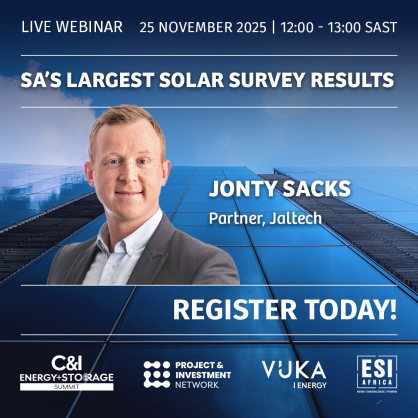
Enlit Africa and Jaltech will present a webinar of the key insights from the report at 12pm on Tuesday, 25 November 2025. This session is tailored for solar installers/developers, commercial and industrial energy users, and landlords who are considering solar or want to understand current market trends and the impact of solar adoption. Register here: https://apo-opa.co/3MdCXT2
In the commercial and industrial market, the use of energy management systems (EMS) is rising, helping users optimise performance, monitor savings, and reduce wastage, an indication that South African businesses are becoming more energy savvy, driven by the high cost of power. For 54% of business users surveyed, solar now offsets the majority of their energy consumption.
"South Africa's solar market has matured rapidly," says Jonty Sacks, partner at Jaltech. "What began as a response to unreliable electricity supply has become a core financial decision. Solar now represents cost stability, resilience and long-term savings for South Africans from day one."
Respondents included homeowners and businesses across diverse sectors, from retail malls and commercial property to agriculture and manufacturing.
The full survey can be accessed here: https://apo-opa.co/487ALDZ
Distributed by APO Group on behalf of VUKA Group.About Enlit Africa:
Enlit Africa (https://apo-opa.co/4444Mnd) brings the top manufacturers, associations, institutions, and government leaders together to shape a sustainable, prosperous energy and water future for Africa. A leading power, energy and water conference and exhibition, Enlit Africa is designed to provide a unique platform to connect decision-makers and determine Africa's future direction of travel.
Enlit Africa takes place annually at the CTICC, Cape Town, South Africa. The event is CPD accredited by the SAIEE and SAICE, thereby contributing to the professional development of industry experts.
For more information, please visit the Enlit Africa website (https://apo-opa.co/4444Mnd).
About Jaltech:
Jaltech is a leading alternative investment and renewable energy fund manager, financing solar installations across South Africa. The firm has funded over R1 billion in commercial solar assets, helping businesses and homeowners reduce their electricity costs while supporting the country's transition to cleaner energy.
About VUKA Group:
VUKA Group (https://WeAreVUKA.com/) brings people and organisations together to connect with information and each other in meaningful conversations to reach the next level of growth in their industry ecosystem. With 20 years of experience in Africa, the group serves the Energy, Mining, Smart Mobility, Transport and Retail sectors, through a range of industry touchpoints across digital, print and in-person platforms. With a commitment to data at its core, the group is well-positioned to support industry stakeholders today and into the future. Operating from Cape Town, South Africa the group is actively involved in projects across continental Africa and boasts a diverse African team who take great pride in the work they do for the sectors and markets they serve.
30th Conference of the Parties (COP30): African Development Bank Group’s (AfDB) Sustainable Energy Fund for Africa (SEFA) mobilises nearly EUR50 million in new commitments...

The African Development Bank Group's Sustainable Energy Fund for Africa (SEFA) (www.AfDB.org), a multi-donor special fund managed by the Bank Group, has secured new investment commitments totalling nearly EUR 50 million, to strengthen the rollout of Mission 300 (https://apo-opa.co/48qxL74) and accelerate climate action across Africa's power sector.
The commitments, made by the governments of Germany and Italy, were announced at a COP30 side event held at the Africa Pavilion on 14 November. Germany committed EUR 14 million to support SEFA's universal energy access goal, and EUR 30 million for the new SEFA green hydrogen programme, reflecting the strategic importance of this emerging sector for Africa's decarbonisation and industrial development. Italy also announced a new contribution of five million euros to the fund.
Dr Katharina Stasch, Director-General for Climate Policy of the Federal Ministry for Economic Cooperation and Development (BMZ), said: “We see the Africa-owned and Africa-led African Development Bank as an excellent partner in unlocking the potential of a green hydrogen economy for African countries.
“By working together, we can create a ‘win–win': partner countries benefit from new energy resources, industrial development, technology transfer, and new jobs while Europe diversifies its future energy imports. Through our partnership with the African Development Bank and SEFA, we hope to create positive tipping points for the market ramp-up of green hydrogen.”
Roberto Amerise, Director for General Affairs, Financial Programmes, and International Cooperation at the Italian Ministry of the Environment and Energy Security (MASE), highlighted the strong commitment of the Italian Government towards Africa, considered a priority for national energy and climate policies. He stressed the importance of encouraging private investment to accelerate the continent's energy transition and sustainable development. Amerise also announced a new contribution of 5 million euros to the SEFA Special Fund for 2025.
"These resources," he said, "reaffirm our collective commitment to advancing SEFA's strategic objectives and accelerating the implementation of renewable energy and energy access projects in Africa that drive sustainable development."
Commenting on the new commitments, Dr Kevin Kariuki, Vice-President, Power, Energy, Climate Change and Green Growth, AfDB, said: "Today's deliberations and commitments at COP30 powerfully reaffirm the urgent need for a unified, bolder approach to Africa's energy transition, resilience and security. The new commitments from Germany and Italy will constitute wind in the sails for Mission 300 goals and solidify SEFA's centrality in Africa's universal energy access journey".
The event, moderated by Dr Daniel Schroth, the Bank's Director for Renewable Energy and Energy Efficiency, also acknowledged the ongoing support from partners like Norway, with Hans Olav Ibrekk, Special Envoy for Climate, reiterating the country's commitment to mobilising private sector investments for the success of Mission 300.
A central theme of the event was the vital role of blended finance in de-risking investments and attracting commercial capital to achieve M300 goals. Attendees learned about projects such as the landmark Obelisk facility in Egypt – a 1 GW Solar PV and 200 MWh Battery Energy Storage System (BESS) co-financed by AfDB and SEFA – with insights shared by Terje Pilskog, CEO of Scatec.
The discussions also featured the impactful work of BURN, a successful African clean cooking company and SEFA grant recipient. Caroline Amollo, BURN's Director of Corporate Affairs, demonstrated through their proven market operations how innovative models are effectively driving affordability and widespread adoption.
Speakers highlighted the importance of predictable and attractive regulatory frameworks to attract private capital for a just and equitable energy transition, focusing on bankable, scalable, and human-centred projects, especially in clean cooking. They also stressed the need to leverage declining renewable energy costs through efficient deployment of development funding. The event reinforced collective commitment to integrating energy transition cooperation within broader climate diplomacy, demonstrating that with concerted effort, the goals of M300 and the broader climate ambitions articulated at COP30 are attainable.
Distributed by APO Group on behalf of African Development Bank Group (AfDB).Media Contact:
Communication and External Relations
media@afdb.org
Making Universal Energy Access Africa’s Top Climate Priority (By Rolake Akinkugbe-Filani)
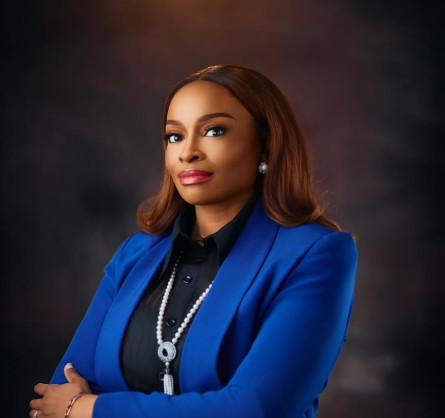
By Rolake Akinkugbe-Filani - CEO, EnergyInc Advisors (www.EnergyIncAdvisors.com) /Global Energy Finance and Strategy Leader
With COP30 underway in Belém, Brazil, the global community is once again confronted with the urgency of climate action. For Africa however, the conversation must begin with a more fundamental question: how do we power the continent so that climate ambition does not outpace development reality?
While advanced economies frame climate progress around how quickly they can retire fossil fuels, Africa's challenge is more foundational. Millions still lack reliable electricity. Without power, factories cannot operate, digital economies cannot thrive, and essential services - from hospitals to schools - remain constrained. Energy access is not merely a development aspiration. It is the bedrock upon which climate adaptation, resilience, and long-term economic transformation rest.
A transition that must be sequenced, not rushed
Africa's clean energy potential is undeniable; abundant solar irradiation, strong wind corridors, hydro resources and world-class geothermal prospects. But potential alone will not close the energy gap. Grid constraints, weak storage systems, and limited industrial-scale capacity mean the transition must be phased and sequenced.
Renewables cannot shoulder the entire burden today. Managed, time-bound use of transitional fuels, including natural gas, remains essential to stabilising grids, supporting industry, and powering cities. This is not a call for indefinite fossil fuel dependence, but for a pragmatic pathway that allows Africa to scale clean energy without undermining growth.
Africa's priorities at COP30: clarity and ambition
Africa produces less than 4 percent of global emissions but absorbs a disproportionate share of the climate fallout, droughts, floods, food insecurity, and displaced communities. Yet climate finance flows to the continent remain slow, fragmented, and heavily skewed toward mitigation rather than the adaptation Africa urgently needs.
At COP30, Africa's message is focused and uncompromising (https://apo-opa.co/4psssKd):
- A new global climate finance target: no less than $1.3 trillion annually by 2030, with a significantly higher share allocated to adaptation, resilience and concessional finance.
- A fully operationalised Loss and Damage Fund, designed to deliver predictable, timely support without adding to Africa's debt burdens.
- A just and inclusive energy transition, one that recognises Africa's right to industrialise, create jobs and expand access while lowering emissions in a responsible and realistic way.
- Recognition of Africa's natural ecosystems - forests, mangroves, peatlands - as global public goods, deserving of sustained financing and market mechanisms that reward their stewardship.
Universal energy access must be the anchor of Africa's climate roadmap
African governments and their partners must weave energy access into the heart of climate policy. This means scaling renewable energy investments, strengthening grids, reforming utilities, and designing transition pathways that reflect Africa's demographics, industrial goals, and financing constraints.
Transitional fuels will continue to play a bridging role, but with transparent timelines and a clear strategy for shifting to cleaner sources as infrastructure matures. What Africa needs is not a binary choice between fossil and renewable, but a plan that delivers power where it is needed most, reliably, affordably, and sustainably.
Because as the world races toward net zero, the continent cannot remain energy-poor. A climate strategy that does not lift African households, clinics and schools out of energy poverty is neither just nor durable.
At COP30, the message must be unmistakable, it is that Africa's development cannot be deferred, and energy access is central to that vision. A fair global climate future begins with a lit Africa, one where power enables productivity, resilience, and opportunity for all.
Driving Africa's energy future through homegrown solutions
Africa's transition will not be unlocked by ambition alone; it will be unlocked by sequencing and by capital. The continent cannot afford a transition model that demands synchronisation with wealthier economies while our grids remain weak and our capital systems under leveraged. With over $900 billion in pension, insurance, and sovereign assets, Africa holds significant pools of domestic capital that remain largely absent from energy infrastructure. The real opportunity now is to finance Africa's transition with Africa's money, in the right order: strengthen grids, scale renewables, and phase out transitional fuels as capacity deepens.
A transition that is both sequenced and self-financed is not only more realistic; it is the most sustainable path to universal energy access and long-term climate resilience.
Distributed by APO Group on behalf of EnergyInc Advisors.Senegal’s Minister of Energy, Petroleum and Mines Invites Energy Stakeholders to MSGBC 2025
Download logo
Birame Souleye Diop, Minister of Energy, Petroleum and Mines of Senegal, has invited all energy stakeholders to participate in the MSGBC Oil, Gas & Power 2025 Conference and Exhibition, taking place on December 8–10 in Dakar.
Speaking during a press conference on Thursday, he emphasized that the conference has become a cornerstone of African energy cooperation and called on institutions, companies and regional partners to join the dialogue shaping the next phase of the MSGBC basin's development.
Taking place under the theme Energy, Oil and Mining in Africa: Synergies for Inclusive Economic Development, MSGBC Oil, Gas & Power 2025 Conference and Exhibition will be held under the patronage of Bassirou Diomaye Faye, President of Senegal and in partnership with the Ministry of Energy, Petroleum and Mines, the national oil company Petrosen and state-owned COS Petrogaz.
“The MSGBC region–Mauritania, Senegal, The Gambia, Guinea-Bissau and Guinea-Conakry–is not just a geological basin. It is a community of shared destiny, united by one ambition: to transform our resources into drivers of inclusive and sustainable growth,” Minister Diop said, adding that the event is a platform for institutions, companies and international investors to explore new opportunities and forge partnerships across the region.
During his address, Minister Diop highlighted bp and Kosmos Energy's Greater Tortue Ahmeyim gas projects (GTA) as a key example of cross-border partnership.
“GTA is a symbol of successful cooperation and economic integration,” the Minister said. Phase 1 of the project began producing gas in December 2024, with 20–25% expected to supply domestic power and industrial needs. Plans for Phase 2 could raise production to around 5 million tons of LNG per year, while technical inspections have confirmed stable operations.
He noted Senegal's Gas-to-X strategy, saying, “Our goal is to transform gas into electricity, industrial inputs, fertilizers and cleaner fuels.” He explained that the strategy supports economic diversification while positioning gas as a complement to renewable energy in the country's energy transition.
Minister Diop also emphasized strengthening local content. “Every project must benefit our citizens first,” he said.
Recent initiatives in Senegal's energy sector align closely with this strategy. In November 2025, the Senegalese university INPG partnered with global energy company Woodside Energy (https://apo-opa.co/4rq3rB8) on the Sangomar project to expand local capacity, awarding contracts to Senegalese companies and providing skills development for engineers and technicians. Earlier in April 2025, the INPG (https://apo-opa.co/4rc4zIl) signed a tripartite agreement with the state-owned Vocational and Technical Training Fund and the National Committee for Monitoring Local Content to train and integrate 1,000 young professionals by 2026, with a long-term goal of 15,000 by 2029.
Sandra Jeque, Project Director at Energy Capital & Power, stated, “MSGBC 2025 will showcase how the region is developing talent, infrastructure and partnerships that place African capabilities at the center of Africa's energy future.”
Minister Diop concluded, “MSGBC 2025 is a unique opportunity to advance energy access, resource transformation and economic development across the African continent.”
Explore opportunities, foster partnerships and stay at the forefront of the MSGBC region's oil, gas and power sector. Visit www.MSGBCOilGasAndPower.com to secure your participation at the MSGBC Oil, Gas & Power 2025 conference. To sponsor or participate as a delegate, please contact sales@energycapitalpower.com.
Distributed by APO Group on behalf of Energy Capital & Power.G20 African Energy Investment Forum Set to Shape Africa’s Investment Agenda
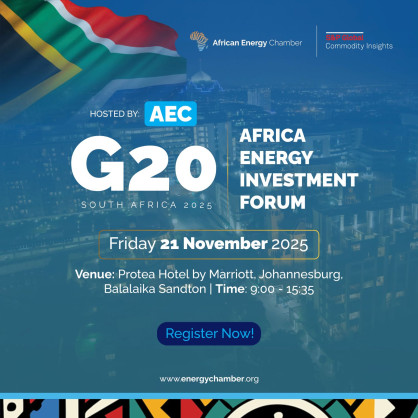
The G20 African Energy Investment Forum – hosted by the African Energy Chamber (AEC) (https://EnergyChamber.org/) – is set to play a defining role in shaping Africa's energy investment landscape ahead of the G20 Leaders' Summit in South Africa. Taking place on November 21, 2025, in Johannesburg, the forum brings together African policymakers, global investors, financiers and energy executives to address the continent's most pressing energy and infrastructure financing needs. With Africa facing annual infrastructure requirements of $130–170 billion across energy, water and transport, the event provides a targeted platform to convert political commitments into bankable projects, catalyze high-level partnerships and accelerate solutions that drive energy access and industrial growth.
As South Africa's G20 presidency places the continent's development at the center of the global agenda, the forum offers investors an early window into policy priorities, regulatory adjustments and investment objectives expected to shape the Summit's outcomes. Discussions will center on de-risking investment, scaling clean and affordable energy, modernizing supply chains and leveraging gas and renewables to anchor long-term economic growth. For participants seeking market intelligence, project pipelines and structured deal flow, the Forum aligns national goals, regional requirements and global capital-market interests.
Strategic Priorities and High-Level Engagement
The program features a full day of keynotes, fireside conversations and technical panels offering practical guidance for investors navigating Africa's energy markets. South Africa's Minister of Energy and Electricity, Kgosientsho Ramokgopa, will deliver opening remarks outlining South Africa's policy direction as G20 host. A fireside conversation with Wale Tinubu, CEO of Oando, will explore corporate growth strategies, diversification and upstream expansion, while Godfrey Moagi, CEO of the South African National Petroleum Company, will discuss refinery modernization and supply-chain resilience.
A series of high-level panels will examine policy tools that balance affordability, sustainability and security; regulatory interventions required to unlock private capital; and mechanisms to mitigate currency, sovereign and macroeconomic risks. Additional sessions will address national LPG and clean-cooking strategies, investment in storage and refining capacity and financing structures supporting gas, power and industrialization goals. Speakers include senior executives from Standard Bank, S&P Global, the African Refiners & Distributors Association, Eskom, Anglo American, PetroSA and Petredec, alongside moderators from SABC, Channel Africa and CLG.
The Forum will spotlight a range of investment-ready opportunities across the energy value chain: upstream acreage, gas monetization projects, refinery upgrades, national LPG expansion programs, utility-scale solar and wind, gas-to-power, baseload generation, grid modernization and emerging opportunities in digital energy systems, battery storage and carbon markets. With governments and sponsors present, investors gain direct exposure to bankable projects aligned with Africa's industrialization and energy-security priorities.
Investment, Innovation and the Road to G20
With the G20 Leaders' Summit taking place days later, the forum serves as a key platform feeding into global-level negotiations. Core discussions will align with South Africa's push for a G20 action plan on affordable and just energy transitions, enhanced multilateral financing and a new investment pact for Africa. The program will highlight how blended finance, public-private partnerships and risk-mitigation tools can accelerate implementation across hydrocarbons, renewables and next-generation energy technologies.
By convening decision-makers across government, finance and industry, the G20 African Energy Investment Forum offers participants clear insight into upcoming policy shifts, bankable investment prospects and technology trends shaping the future. For investors, developers and financiers seeking clarity, access and actionable deal flow, it stands as a must-attend platform defining Africa's energy agenda in the G20 era.
Distributed by APO Group on behalf of African Energy Chamber.