
Explore more Articles in
Industrial
Sonatrach-Ghana National Petroleum Corporation (GNPC) Research and Development (R&D) Partnership Signals Africa’s Energy Future is Innovation-Led

Download logo
Algeria's state-owned oil company Sonatrach and the Ghana National Petroleum Corporation (GNPC) have signed a Memorandum of Understanding (MoU) under the auspices of the African Petroleum Producers Organization (APPO), formalizing plans for a strategic partnership focused on research, development and innovation (R&D) in the oil and gas sector. Signed in Brazzaville, the Republic of Congo - the headquarters of APPO - and in the presence of APPO's recently appointed Secretary General Farid Ghezali, the MoU establishes a framework for assessing joint opportunities, sharing expertise and creating structured working mechanisms to support the development of hydrocarbon resources for energy security and sustainable development across Africa.
The African Energy Chamber (AEC) welcomes the agreement and expresses its full support for Sonatrach and GNPC in advancing African-led R&D collaboration. The agreement signifies APPO as not only an instrumental part in facilitating the partnership but a central force in bringing all parties together to ratify this important deal. Under the leadership of Ghezali, APPO continues to showcase its commitment to unifying nations - as well as the broader industry - to reach decisive agreements such as this one. The partnership also reflects a growing recognition among national oil companies (NOC) that innovation, technology and knowledge-sharing are essential to unlocking value, reducing costs and ensuring Africa remains competitive in a rapidly evolving global energy market. The AEC believes that this collaboration is expected to move the entire industry into its next phase of development.
The scope of cooperation outlined in the MoU is both comprehensive and forward-looking. It includes advanced onshore and offshore seismic technologies such as high-definition processing and interpretation, artificial intelligence-enabled subsurface analysis, 4D seismic and real-time reservoir modeling. The agreement also covers digital wells and digital oilfields, enhanced and improved oil recovery, stratigraphic exploration objectives, integrity and corrosion management and oil and gas valorization - capabilities that directly improve recovery rates, extend the life of producing assets and maximize returns from existing infrastructure. The partnership also integrates energy transition and environmental priorities alongside core upstream development. Areas of cooperation include carbon footprint reduction, low-carbon industrial solutions, hydrogen and green technologies, as well as water and waste treatment and air pollution mitigation. This reflects a pragmatic African approach: developing hydrocarbons responsibly while embedding sustainability and emissions management into project design and operations from the outset.
The agreement comes at a critical time for both markets. For Ghana, the MoU signals a commitment to leveraging innovation to revitalize oil production as the nation looks to revive oilfields, diversify the industry through gas and support broader regional energy growth. With 17 oil and gas projects scheduled for development by 2027, Ghana is working to expand exploration, ramp up production and deepen private sector participation. Recent milestones point to a strong resurgence across the market. Just this month, Kosmos Energy announced that it successfully drilled and completed the J-74 well - part of the larger 2025-2026 Jubilee field development campaign. In partnership with the GNPC and Tullow, the company plans to drill 20 wells at Jubilee under a $2 billion upstream expansion plan, five of which are planned for 2026. Alongside oil Ghana is advancing gas developments under efforts to monetize its over 2.1 trillion cubic feet of available resources. Projects such as a planned second processing plant - with a capacity of 150 million standard cubic feet per day - are underway and will complement operational facilities such as the Atuabo Plant.
As one of Africa's biggest oil and gas producers, Algeria is well-positioned to support Ghana's hydrocarbon goals. The country is advancing its own ambitious hydrocarbon strategy, anchored by a five-year plan endorsed by Sonatrach that will mobilize up to $60 billion in investment. The program prioritizes sustained exploration and production to offset natural decline, alongside the modernization and expansion of downstream infrastructure to strengthen value addition, boost export capacity and enhance long-term energy security. Through this strategy, Algeria is reinforcing its role as a continental energy leader while generating technical expertise and operational know-how that can be leveraged through partnerships with peers such as GNPC. By prioritizing R&D, embracing technology and aligning hydrocarbons development with sustainability objectives, Sonatrach and GNPC are setting a strong precedent. The AEC commends both companies and APPO for advancing an African-led model that supports energy security, economic growth and sustainable development across the continent.
“APPO continues to showcase a commitment to advancing Africa's hydrocarbon development. This MoU shows that African NOCs are investing in innovation to secure the continent's energy future. Research and technology are critical to producing oil and gas more efficiently and sustainably, while supporting the broader energy transition. Africa needs oil and gas to develop, and partnerships like this ensure those resources deliver long-term value for our people,” stated NJ Ayuk, Executive Chairman, AEC.
Distributed by APO Group on behalf of African Energy Chamber.Floating Liquefied Natural Gas (FLNG) and Africa’s Gas Future: A Flexible Solution for Accelerated Liquefied Natural Gas (LNG) Development
Download logo
Floating liquefied natural gas (FLNG) is rapidly emerging as a cornerstone of Africa's gas development strategy, as the continent prepares for a sharp rise in demand and seeks faster, more resilient pathways to market. According to the African Energy Chamber's (AEC) (https://EnergyChamber.Org) State of African Energy 2026 Outlook, Africa's natural gas demand is projected to increase by 60% by 2050, underscoring the urgency of bringing new supply online efficiently and at scale. At the same time, Africa already hosts the highest concentration of FLNG infrastructure globally, positioning the continent as a natural testbed for floating solutions that monetize offshore resources while mitigating above-ground risks.
Accelerated FLNG Deployment
Early FLNG successes are already reshaping development models across the continent. Cameroon's Hilli Episeyo FLNG project stands as Africa's first operational FLNG facility and a global reference point. Brought online in record time, the project demonstrated how FLNG can rapidly unlock gas exports from relatively modest reserves. Since then, Africa's FLNG market has expanded, with several projects now under development or in operation.
On the maritime border of Senegal and Mauritania, the Gimi FLNG vessel – situated at the bp-led Greater Tortue Ahmeyim LNG development and operated by Golar LNG – reached its commercial operations date in 2025. As the first FLNG unit deployed in the MSGBC region, the vessel will monetize up to 15 trillion cubic feet of gas through a 20-year Lease and Operate Agreement.
In Gabon, Perenco is developing the Cap Lopez FLNG project with a capacity of 700,000 tons per year, starting in 2026, with the unit being built by Dixstone. Offshore Nigeria, UTM Offshore is developing an FLNG facility at the deepwater Yoho field, a $5 billion project progressing toward FID. As Africa positions itself for the next phase of gas-led growth, FLNG stands out as a practical, future-focused solution – one that aligns technical innovation with the continent's urgent development needs and long-term energy ambitions.
Implications for the Sector
One of FLNG's most compelling advantages is scalability. Unlike onshore LNG developments, which require extensive land acquisition, supporting infrastructure and long construction timelines, FLNG facilities can be deployed in phases and scaled according to reservoir performance and market demand. This modular approach reduces upfront capital requirements and allows producers to accelerate first gas while preserving optionality for expansion. The Congo LNG project illustrates this approach: following phase one operations in 2023, operator Eni moved quickly toward phase two, bringing production online in 2025 – just 35 months after construction began and six months ahead of schedule. With first exports set for 2026, the project demonstrates how FLNG can be developed at speed and scale.
FLNG also helps mitigate above-ground risks – an issue shaping gas development strategies across Africa. Mozambique offers a clear example. Despite hosting some of the world's largest gas discoveries, security challenges in Cabo Delgado caused delays and force majeure declarations on major onshore LNG projects. Offshore FLNG developments, however, have proven more resilient. Eni brought the Coral Sul FLNG project online in 2022, with the Coral Norte FLNG project reaching a $7.2 billion FID in 2025. While projects such as Mozambique LNG and Rovuma LNG faced delays, Coral utilized FLNG to reduce exposure to onshore security threats and logistical bottlenecks, enabling continued operations even in complex environments.
Making Energy Poverty History Through Gas
Beyond speed and resilience, FLNG could become a catalyst for Africa's broader economic development. By reducing capital intensity and shortening development timelines, FLNG improves project bankability and attracts a wider pool of investors. It also supports gas-to-power strategies, petrochemical development and regional energy security by enabling monetization of gas that might otherwise remain stranded for years.
However, FLNG is not a one-size-fits-all solution. Successful deployment requires robust regulatory frameworks, clear fiscal terms and strong collaboration between governments, operators and financiers. When aligned with national gas master plans and long-term industrial strategies, FLNG can serve as a powerful bridge between exploration success and sustainable economic impact.
These discussions will be central at African Energy Week (AEW) 2026, where governments and industry leaders will explore how floating solutions can unlock Africa's vast gas potential while managing risk and accelerating timelines. AEW continues to provide a critical platform for sharing lessons learned, advancing project dialogue and mobilizing capital into innovative LNG developments.
“FLNG is changing the game for African gas producers. It allows countries to monetize resources faster, reduce exposure to security and infrastructure risks, and generate revenues that can be reinvested into broader development. When deployed strategically, FLNG can help Africa turn gas discoveries into energy security, industrial growth and real economic transformation,” states NJ Ayuk, Executive Chairman, AEC.
Distributed by APO Group on behalf of African Energy Chamber.Kenya Engineer Releases Volume 54, Issue 1 (January–February 2026), Now in Circulation
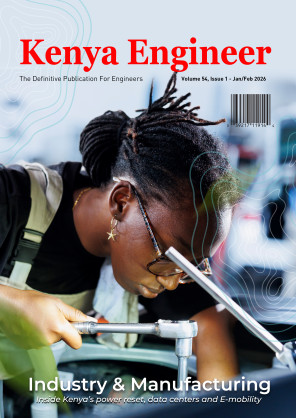
Kenya Engineer Magazine (www.KenyaEngineer.co.ke) has released the January–February 2026 issue, marking the first issue of Volume 54 and reaffirming the publication's long-standing role as a trusted platform for engineering insight in Kenya, East Africa, and beyond.
For more than five decades, Kenya Engineer has documented the evolution of engineering practice, industry, and policy across the region. The latest issue is published at a time when engineering is increasingly central to energy transition, industrial growth, infrastructure development, and sustainability, and it continues the magazine's commitment to professionally grounded, context-driven content.
Focus of the January–February 2026 Issue
The new issue brings together analysis, interviews, and features examining key developments shaping the engineering and industrial landscape, including:
- Power and energy sector developments and their implications for industry
- Grid stability, transmission, and infrastructure readiness
- Manufacturing and industrialisation in Kenya and across Africa
- Engineering leadership, policy alignment, and skills development
- Emerging trends in sustainability and electric mobility
Rather than reporting events in isolation, the issue places emphasis on context, relevance, and long-term implications, offering insight that remains valuable to professionals, institutions, and decision-makers beyond the news cycle.
A Trusted Platform for the Engineering Ecosystem
Kenya Engineer continues to serve a diverse readership that includes practicing engineers, technical managers, utilities, manufacturers, EPC firms, regulators, policymakers, and academic institutions. Its positioning as a credible, independent platform has made it a reference point for industry dialogue and professional reflection across the region.
As engineering challenges grow more complex and interconnected, the publication remains focused on supporting informed discussion that links engineering practice, industry needs, and development priorities.
Availability
The January–February 2026 issue is now in circulation and is available in both print and digital formats, ensuring accessibility for readers locally and internationally. In addition to individual copies, annual print subscriptions covering six issues are also available for professionals, firms, and institutions that rely on Kenya Engineer as a reference publication.
Digital download link - https://apo-opa.co/3N0wueV
Print copy order - https://apo-opa.co/3Yrurmw
Distributed by APO Group on behalf of The Kenya Engineer.For further information:
www.KenyaEngineer.co.ke
info@kenyaengineer.co.ke
admin@kenyaengineer.co.ke
About Kenya Engineer:
Kenya Engineer is a professional engineering magazine serving East Africa and beyond. It provides news, analysis, and features across power, infrastructure, manufacturing, automation, sustainability, and emerging technologies, with a focus on engineering-led development. The publication has served the engineering community for over 50 years.
Global Service Providers, Industrial Specialists Join the Libya Energy & Economic Summit (LEES) 2026 as Bronze Sponsors
Download logo
The Libya Energy & Economic Summit (LEES) 2026 (https://LibyaSummit.com), taking place in Tripoli from January 24-26, continues to attract a broad cross-section of international and regional companies aligned with Libya's upstream growth, infrastructure modernization and economic revitalization agenda. The event has confirmed (Kellogg Brown & Root) KBR , TGS, Bharat Tanks & Vessels (BTV), Go Gas Holding, Regus and SIXT as Bronze Sponsors, underscoring strong private-sector engagement as Libya accelerates toward its production and investment targets.
The participation of these companies reflects growing confidence in Libya's reform-driven energy strategy, which combines aggressive upstream expansion with renewed focus on gas monetization, logistics, infrastructure and investor enablement. Together, the Bronze Sponsors represent the technical depth, advisory expertise and operational support required to translate policy momentum into executable projects.
Global engineering and advisory firm KBR brings decades of experience in Libya, spanning upstream engineering, infrastructure planning and government advisory services. As a strategic partner to Libya's National Oil Corporation (NOC) (https://apo-opa.co/3Ll9nLh), KBR is providing feasibility studies, technical reviews and project delivery frameworks across oil, gas, power and infrastructure. Its long-standing footprint positions KBR as a key enabler of Libya's next investment cycle.
Energy data and intelligence company TGS supports Libya's upstream revival through advanced subsurface analytics and seismic data coverage. With one of the world's largest energy data libraries, TGS provides 2D and 3D seismic datasets that help governments and operators de-risk exploration and accelerate decision-making, particularly relevant as Libya opens new acreage across the Sirte, Murzuq and Ghadames basins.
India-based BTV joins LEES 2026 as Libya prioritizes midstream and downstream infrastructure upgrades. Specializing in ASME-certified pressure vessels, LPG spheres, cryogenic tanks and transport equipment, BTV is positioned to support storage and distribution systems for LNG, LPG, ammonia and emerging fuels. Its capabilities align with Libya's need to modernize fuel logistics while preparing for future energy vectors such as hydrogen and CO₂ handling.
Go Gas Holding, a regional energy company active in Libya's gas value chain, reflects the growing emphasis on gas capture, domestic supply and downstream infrastructure. As Libya advances projects at Waha, Bouri and the Western Libya Gas Project, Go Gas' focus on distribution and logistics complements national efforts to improve power generation and reduce flaring.
Beyond energy operations, Regus and SIXT support the broader investment ecosystem. Regus provides flexible office infrastructure in Tripoli, enabling international firms to establish rapid local presence, while SIXT – operating through its Libyan franchise – delivers secure mobility solutions for executives, project teams and summit delegates.
“The participation of these Bronze Sponsors reflects the depth and diversity of expertise required to support Libya's energy resurgence, from upstream advisory and data to infrastructure, logistics and investor enablement. Their engagement at LEES 2026 underscores growing international confidence in Libya's reform agenda and the opportunities emerging across the entire energy value chain,” states James Chester, CEO, Energy Capital & Power.
Together, the Bronze Sponsors reinforce LEES 2026's role as a convergence point for operators, service providers and investors shaping Libya's energy and economic future.
Distributed by APO Group on behalf of Energy Capital & Power.Africa Finance Corporation Acts as Co-Financial Adviser for Angola’s Lobito Atlantic Railway Concession

Africa Finance Corporation (AFC) (www.AfricaFC.org), the continent's leading infrastructure solutions provider, has announced the signing of key financing agreements for the Lobito Atlantic Railway Project in Angola. AFC alongside Eaglestone, acted as Co-Financial Adviser, to Lobito Atlantic Railway S.A. (LAR), the Borrower and Concessionaire of the 1,300-kilometre brownfield railway corridor.
This transformational transport infrastructure initiative is backed by leading sponsors including Mota-Engil, a multinational engineering and construction group with a strong presence across Africa; Trafigura, one of the world's leading independent commodities trading and logistics companies, and Vecturis, an international rail operator with extensive experience in freight rail concessions, mobilising world-class technical, operational and commercial expertise to ensure the long-term success of the corridor.
The signing of the US$753 million financing package- consisting of US$553 million from the U.S. International Development Finance Corporation (DFC) and US$200 million from the Development Bank of Southern Africa (DBSA), marks a major milestone for the Lobito Atlantic Railway, a flagship regional infrastructure project that will rehabilitate, upgrade and operate the 1,300-kilometer brownfield rail line connecting the Port of Lobito on Angola's Atlantic coast to the Democratic Republic of Congo (DRC) border, strengthening regional integration and improving access to global markets.
Beyond its trade and logistics benefits, the project is expected to deliver substantial development impact, including job creation during construction and operation, skills development, improved safety standards, and long-term economic opportunities for communities along the corridor. The financing package is expected to increase Lobito's transportation capacity ten-fold to approximately 4.6 million metric tonnes per annum and to reduce the cost of transporting critical minerals by an estimated 30 percent.
“The signing of the financing agreements for the Lobito Atlantic Railway demonstrates the strength of AFC's financial advisory expertise in structuring and advancing complex, cross-border infrastructure transactions of strategic significance. This initiative aligns with AFC's broader development efforts to deliver a transformational transport corridor linking Angola, the DRC, and the wider Southern Africa region, reinforcing the critical role of integrated rail and port infrastructure in unlocking regional trade, industrial growth and supply-chain resilience”, said Samaila Zubairu, President and CEO of Africa Finance Corporation. The Lobito Corridor is also of particular importance for Angola, one of AFC's valued member countries and shareholders, reaffirming our long-standing commitment to supporting the country's infrastructure development and economic priorities”, he added.
Nuno Gil, Founding Partner of Eaglestone, said: “We are delighted to have advised LAR in this landmark transport infrastructure transaction that is a key milestone to unlock regional trade and boost economic activity along the Lobito Corridor. The Eaglestone (http://apo-opa.co/49hIMqp) team can be proud in once again delivering world-class services within the project finance advisory industry in Southern Africa.”
Manuel Mota, Deputy CEO of Mota-Engil, said: “The signing with DFC, DBSA, and the Government of Angola marks the culmination of long-term collaboration, together with our partner, Trafigura, to advance the Lobito Corridor. This strategic agreement will expand transport capacity, reduce transit costs, and open access to the mineral-rich regions of the Democratic Republic of Congo and Zambia. Mota-Engil's participation underscores its commitment to deliver an infrastructure that supports Angola's national priorities, economic diversification, and regional connectivity. This strategic financing not only enables further investment in the project but also reinforces confidence in Angola's institutional capacity to attract interest for world-class infrastructure initiatives. We appreciate the expert advisory support from Eaglestone and AFC, whose guidance was instrumental in structuring this financing.”
Richard Holtum, CEO of Trafigura, said: “We are pleased that Lobito Atlantic Railway has secured financing from DFC and DBSA to further advance the rehabilitation and operation of the line in Angola. As a shareholder of LAR, we see the railway as a key domestic and regional asset that will drive economic development and support the movement of critical metals to global markets.”
AFC and Angola have forged a strong and mutually beneficial partnership over the years, strengthened by Angola's accession as an AFC member state in 2022 and its progression to shareholder status in 2025. Today, AFC is deepening its footprint in the country through a growing portfolio of advisory and investment engagements across infrastructure, energy and industrial sectors, including AFC's complementary greenfield railway project connecting to Angola.
Distributed by APO Group on behalf of Africa Finance Corporation (AFC).Media Enquires:
Yewande Thorpe
Communications
Africa Finance Corporation
Mobile: +234 1 279 9654
Email: yewande.thorpe@africafc.org
About AFC:
AFC was established in 2007 to be the catalyst for pragmatic infrastructure and industrial investments across Africa. AFC's approach combines specialist industry expertise with a focus on financial and technical advisory, project structuring, project development, and risk capital to address Africa's infrastructure development needs and drive sustainable economic growth.
Eighteen years on, AFC has developed a track record as the partner of choice in Africa for investing and delivering on instrumental, high-quality infrastructure assets that provide essential services in the core infrastructure sectors of power, natural resources, heavy industry, transport, and telecommunications. AFC has 47 member countries and has invested over US$17 billion in 36 African countries since its inception.
The Islamic Corporation for the Development of the Private Sector (ICD) extends USD 20 million Islamic financing to expand Jordan’s non-woven fabrics industry
Download logo
- USD 20 million medium-term Islamic finance facility to expand non-woven fabrics production capacity through advanced Spunlace equipment.
- API is Jordan's leading non-woven fabrics manufacturer, producing essential materials for personal hygiene products, healthcare PPE including gowns and face masks, and agricultural applications.
- The expansion aims to create substantial employment opportunities, strengthening Jordan's industrial competitiveness and economic diversification.
- Supports UN SDGs including Decent Work and Economic Growth, Industry and Innovation, and Partnerships for the Goals.
The Islamic Corporation for the Development of the Private Sector (ICD) (www.ICD-ps.org), the private sector arm of the Islamic Development Bank (IsDB) Group, has recently extended USD 20 million medium-term Islamic finance facility to Applied Plastic Industries Company (API), the leading manufacturer of non-woven fabrics in Jordan. The facility will finance capital expenditure for advanced Spunlace equipment, enabling API to establish a new production line and expand its manufacturing capacity.
The financing will enable API to acquire cutting-edge Spunlace technology, enhancing production efficiency and product diversification. This investment supports Jordan's manufacturing sector modernization while contributing to the country's broader economic development objectives through sustainable industrial growth.
Commenting on the financing, Dr. Khalid Khalafalla, Acting Chief Executive Officer of ICD, stated: "This financing facility exemplifies ICD's strategic commitment to advancing industrial development across our member countries. By partnering with Applied Plastic Industries, we are making a targeted investment in Jordan's manufacturing value chain that aligns with the nation's economic diversification objectives. This transaction demonstrates the powerful role of Shariah-compliant finance as a catalyst for private sector expansion, job creation, and inclusive economic development. The expansion of API's production capacity will strengthen Jordan's competitive position in regional non-woven fabrics markets while creating meaningful employment opportunities that directly contribute to sustainable development."
Mr. Radwan Khattab, General Manager of Applied Plastic Industries Company, said: "We are honored to partner with ICD, a globally respected development finance institution that shares our vision for sustainable industrial growth. This financing facility represents a transformational milestone for API, enabling us to acquire state-of-the-art Spunlace technology that will enhance our production capabilities and product quality. The investment will not only expand our market reach regionally but will also create substantial employment opportunities for Jordanian professionals and skilled workers. We are committed to contributing to Jordan's economic development agenda and are confident that this partnership with ICD will strengthen our position as a leading manufacturer in the Middle East's non-woven sector."
This initiative advances ICD's mission to foster sustainable economic development in its member countries. By channeling capital into Jordan's manufacturing sector, the project aims to create substantial employment opportunities, enhance industrial competitiveness, and support the United Nations Sustainable Development Goals, particularly SDG 8 (Decent Work and Economic Growth), SDG 9 (Industry, Innovation and Infrastructure), and SDG 17 (Partnerships for the Goals).
The expansion project aligns strategically with Jordan's national objectives of fostering economic growth, creating quality employment opportunities, and advancing the nation's vision of becoming a sustainable and competitive regional economy.
Distributed by APO Group on behalf of Islamic Corporation for the Development of the Private Sector (ICD).For Media Inquiries:
Nabil El-Alami
Communications & Corporate Marketing Division Manager
Email: nalami@isdb.org
Follow ICD on:
X (formerly Twitter) @ icd_ps
LinkedIn @ icdps
Facebook @ icdps
YouTube @ icdps
About Applied Plastic Industries Company (API):
Applied Plastic Industries Company (API), established in 2019, is a prominent manufacturing entity in Jordan and a significant player in the Middle East's non-woven sector. The company produces non-woven fabrics, calcium carbonate, masterbatch, disposable medical clothing, and non-woven reusable bags, leveraging its 540,000 tons annual capacity operated with state-of-the-art German machinery. Known for consistent growth and profitability, API employs 500 individuals and maintains a strong commitment to ongoing human resource development.
About the Islamic Corporation for the Development of the Private Sector (ICD):
The Islamic Corporation for the Development of the Private Sector (ICD) is a multilateral development finance institution and member of the Islamic Development Bank (IsDB) Group. Established in November 1999 and headquartered in Jeddah, Saudi Arabia, ICD supports economic development in its 56 member countries by providing financial assistance to private sector projects in accordance with Shariah principles.
With an authorized capital of USD 4.0 billion and more than 25 years of operational excellence, ICD complements IsDB's activities by promoting capital market development, best management practices, and enhancing the role of market economies. ICD holds strong credit ratings of A2 by Moody's, A+ by Fitch, and A by S&P, reflecting its solid financial standing and commitment to sustainable development.
For more information, visit www.ICD-ps.org