
Afreximbank delivers solid, steady performance for the nine months ended 30 September 2025
Download logo
African Export-Import Bank (Afreximbank or the “Bank”) (www.Afreximbank.com) and its subsidiaries (the “Group”) delivered solid results for the nine months period ended 30 September 2025, underscoring its continued financial resilience.
During the period, the total assets and contingencies rose by 6.98% to US$42.9 billion, up from US$40.1 billion as at 31 December 2024 (FY'2024), highlighting the Bank's consistent growth trajectory.
While Net loans and advances closed at US$28.0 billion (FY 2024: US$29.0 billion), the reduction is largely attributable to unscheduled early repayments by clients whose financial positions have improved on account of enhanced cash flows and stronger foreign-currency positions driven by higher commodity prices. The Bank's asset quality remains sound, evidenced by a Non-Performing Loan (NPL) ratio of 2.51%, compared to 2.33% in FY2024.
The Bank's liquidity position remained strong, with cash and cash equivalents increasing to US$7.6 billion, up from US$4.6 billion in FY2024. This increase was driven by successful and targeted fundraising initiatives and unscheduled early loan repayments from borrowing customers. As a result, the proportion of liquid assets to total assets increased and accounted for 20%, compared to 13% in FY2024. This solid liquidity positions the Group well to support its planned disbursement activities.
Shareholders' funds grew to US$7.7 billion as at 30 September 2025, supported by internally generated profits of US$654.3 million and new equity inflows of US$224.9 million mobilised under the General Capital Increase II. The reported Shareholders' funds balances take into account the US$350 million dividend appropriated from FY'2024 profits.
Despite declining benchmark rates, gross income for the nine months to September 2025, rose to US$2.4 billion compared to US$2.3 billion achieved over the same period last year. Operating income also grew by 5.24% to US$1.44 billion, while maintaining strong cost efficiency with a cost-to-income ratio of 21% which is well below the strategic ceiling of 30%.
Resultantly, Net income also grew, increasing from US$642.2 million in 9M'2024, to US$654.3 million in 9M'2025.
Highlights of the results for Afreximbank Group are shown below:
|
Financial Performance Metrics |
9M'2025 |
9M'2024 |
|
Gross Income (US$ billion) |
2.4 |
2.3 |
|
Net Income (US$ million) |
654.3 |
642.2 |
|
Return on average equity (ROAE) |
12% |
13% |
|
Return on average assets (ROAA) |
2.35% |
2.64% |
|
Cost-to-income ratio |
21% |
17% |
|
Financial Position Metrics |
9M'2025 |
9M'2024 |
|
Total Assets (US$ billion) |
37.6 |
32.2 |
|
Total Liabilities (US$ billion) |
29.9 |
25.6 |
|
Shareholders' Funds (US$ billion) |
7.7 |
6.6 |
|
Net asset value per share (US$) |
72,429 |
66,881 |
|
Non-performing loans ratio (NPL) |
2.51% |
2.42% |
|
Cash/Total assets |
20% |
12% |
|
Capital Adequacy ratio (Basel II) |
25% |
25% |
Mr. Denys Denya, Afreximbank's Senior Executive Vice President, commented:
“Amid persistent geopolitical tensions, global uncertainty, and tight financial conditions, the Group demonstrated resilience and delivered a satisfactory performance for the nine-month period ended 30 September 2025, in line with expectations. This resilience as reflected in strong liquidity, a robust capital base, and high-quality assets, underscores the Group's ability to navigate through the challenging operating environment. Beyond supporting profitability, the demonstrated resilience will serve as a springboard for expanding lending activities, enhancing capacity to deliver on the Group's mandate, and creating sustainable long-term value in line with the 6th Strategic Plan”.
Distributed by APO Group on behalf of Afreximbank.Media Contact:
Vincent Musumba
Communications and Events Manager (Media Relations)
Email: press@afreximbank.com
Follow us on:
X: https://apo-opa.co/486j4Vr
Facebook: https://apo-opa.co/49Nh9aX
LinkedIn: https://apo-opa.co/3LHSP06
Instagram: https://apo-opa.co/48d397R
About Afreximbank:
African Export-Import Bank (Afreximbank) is a Pan-African multilateral financial institution mandated to finance and promote intra- and extra-African trade. For over 30 years, the Bank has been deploying innovative structures to deliver financing solutions that support the transformation of the structure of Africa's trade, accelerating industrialisation and intra-regional trade, thereby boosting economic expansion in Africa. A stalwart supporter of the African Continental Free Trade Agreement (AfCFTA), Afreximbank has launched a Pan-African Payment and Settlement System (PAPSS) that was adopted by the African Union (AU) as the payment and settlement platform to underpin the implementation of the AfCFTA. Working with the AfCFTA Secretariat and the AU, the Bank set up a US$10 billion Adjustment Fund to support countries effectively participating in the AfCFTA. At the end of December 2024, Afreximbank's total assets and contingencies stood at over US$40.1 billion, and its shareholder funds amounted to US$7.2 billion. Afreximbank has investment grade ratings assigned by GCR (international scale) (A), Moody's (Baa2), China Chengxin International Credit Rating Co., Ltd (CCXI) (AAA), Japan Credit Rating Agency (JCR) (A-) and Fitch (BBB-). Afreximbank has evolved into a group entity comprising the Bank, its equity impact fund subsidiary called the Fund for Export Development Africa (FEDA), and its insurance management subsidiary, AfrexInsure (together, "the Group"). The Bank is headquartered in Cairo, Egypt.
For more information, visit: www.Afreximbank.com
FORWARD-LOOKING STATEMENTS:
African Export-Import Bank (Afreximbank) Group makes written and/or oral forward-looking statements, as shown in this release and other communications, from time to time. Likewise, officers of the Bank may make forward-looking statements either in writing or during verbal conversations with investors, analysts, the media, and other members of the investment community. Statements regarding the Bank's strategies, objectives, priorities, and anticipated financial performance for the period constitute forward-looking statements. They are often described with words like "should", "would", "may", "could", "expect", "anticipate", "estimate", "project", "intend", and "believe".
By their very nature, these statements require the Bank to make assumptions subject to risks and uncertainties, especially uncertainties related to the financial, economic, regulatory, and social environment within which the Bank operates. Some of these risks are beyond the control of the Bank and may result in materially different results from the expectations inferred from the forward-looking statements. Risk factors that could cause such differences include regulatory pronouncements, credit, market (including equity, commodity, foreign exchange, and interest rate), liquidity, operational, reputational, insurance, strategic, legal, environmental, and other known and unknown risks. As a result, when making decisions with respect to the Bank, we recommend that readers apply further assessment and should not unduly rely on the Bank's forward-looking statements.
Any forward-looking statements contained in this press release represents the views of management only as of the date hereof. These statements are meant to assist the Bank's investors and analysts to understand the Bank's financial position, strategies, objectives, priorities, and anticipated financial performance in relation to the current period, and, as such, may not be appropriate for other purposes. The Bank does not undertake to update any forward-looking statements, whether written or verbal, which may be made from time to time by it or on its behalf, except as required under applicable relevant regulatory provisions or requirements.
Television: An African culture engine

Television – both its content and its technology – has become the backbone of African culture. As the world marks World Television Day, Dr Busola Tejumola, MultiChoice Executive Head (www.MultiChoice.com), General Entertainment Channels, assesses the impact of a platform still bringing people together after 65+ years on the continent.
As we mark World TV Day, the light that television shines on our society remains undimmed. TV remains one of humanity's greatest connectors. It informs, educates, inspires and entertains – but more importantly, it helps people see themselves and each other in powerful new ways.
Since TV arrived in Africa in 1959, with the launch of Western Nigeria Television, TV has been a vehicle for social connection, cultural exchange and national pride. It gives us shared moments – whether through sports, news or drama – which shape our collective memory.
Africa's entertainment ecosystem
MultiChoice, a CANAL+ company, is Africa's most-loved provider of television entertainment, and incredibly proud of our role in building Africa's entertainment ecosystem.
Since our launch in 1985, MultiChoice has evolved (https://apo-opa.co/49Zelr6) to consistently meet the needs of African audiences. SuperSport launched in 1986; our analogue service reached 20 countries by 1992; we launched digital satellite technology in 1995; and app-based television in 2014. The Showmax streaming service appeared in 2015.
The Africa Magic Viewers' Choice Awards (AMVCA) has grown into a continental celebration of creative excellence in television. The MultiChoice Talent Factory (MTF) has produced 486 graduates and continues to train and empower the makers of TV content across the continent.
Constant tech innovation
We've learned that constant technological evolution is key to maintain the relevance of television in the lives our viewers. Our innovation journey has been driven by customer needs. From HD and 4K broadcasts to the DStv Explora and Catch Up, we have continuously developed how people consume content.
The recent rollout of our DStv Stream and the new Showmax platforms has been another leap forward in delivering content across devices while offering personalised recommendations powered by advanced analytics.
We've also made strides in local-language interfaces, adaptive streaming, and user-friendly payment, making our technology both inclusive and empowering.
Technology brings wider audiences into the TV ecosystem – across urban and rural areas, and income levels. Through digital migration, mobile viewing, and flexible subscription options, more Africans can now access quality entertainment without limitation.
For people and planet
At MultiChoice, we've also come to understand that accessibility means more than just availability – it can also help to ensure that every viewer sees themselves and their culture in Africa's storytelling journey.
Television has also become a vehicle for ESG impact. On the environmental front, we're embracing energy-efficient decoders, eco-friendly packaging, and responsible e-waste practices through decoder take-backs and other initiatives.
Socially, our investments in local content production, skills development through MTF, and community storytelling creates sustainable jobs and cultural capital across Africa. From a governance standpoint, we deploy the latest TV technology for content protection, consumer data privacy and responsible advertising.
Enriching lives
Ultimately, television should add value to people's lives. People want choice, relevance and control. That means providing diverse content offerings, innovative products and personalised experiences.
Today DStv and GOtv offer bouquets priced from US$1, to 50+ countries across Africa, offering subscribers up to 156 linear video channels. The Showmax service is available in 44 markets. Affordable TV platform GOtv launched in 2011 and now reaches eight markets.
We've also learned that true customer value comes from giving people content that resonates, informs and entertains — all while keeping it accessible and affordable.
Television's impact reaches far beyond local markets. Thanks to the power of modern connectivity, the stories of our African creators now travel beyond borders – from Nigeria to Kenya, South Africa to Ghana, and to audiences worldwide – through Showmax and our international content partnerships.
Content like Big Brother Naija, Shake iLembe, the AMVCAs, as well as SuperSport events like the Olympic Games, the FIFA World Cup and CAF Afcon football have become continental touchstones.
Television has also become a bridge connecting Africa to the world and the world to Africa. MultiChoice is proud to have helped to build that that bridge.
At the same time, local content is the soul of African television. It preserves our languages, celebrates our traditions, and projects our creativity to the world. Through regional channels like Africa Magic, Maisha Magic and Zambezi Magic, we've witnessed firsthand how shared storytelling promotes understanding and unity among African nations.
Television has also become a driver of content economies. We've come to understand how commissioning new shows at scale nurtures small business and sustains thousands of creative and technical jobs across African value chains. We produced 5 340 hours of local content in FY2025.
TV evolution
The television landscape is evolving rapidly. We see the rise of hybrid viewing – where linear TV and on-demand streaming complement each other. Personalisation, AI-driven content recommendations, and mobile-first consumption are reshaping how audiences engage.
Local content remains king – audiences want authenticity, representation, and stories that reflect their realities. The future of TV will be driven by data, powered by technology, and grounded in human connection.
For MultiChoice, our strategic focus is to remain Africa's leading storyteller and most trusted entertainment partner. We continue investing in local productions, innovative technology and creative talent development.
Television has shown itself to be an invaluable conduit for culture in all of its forms. Ultimately, our goal is to ensure that every African household has access to diverse, high-quality entertainment that inspires pride, fosters connection, and enriches lives – one story at a time.
Distributed by APO Group on behalf of MultiChoice Group.G20 African Energy Investment Forum Set to Shape Africa’s Investment Agenda
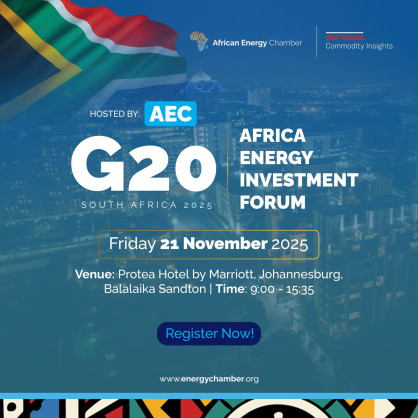
The G20 African Energy Investment Forum – hosted by the African Energy Chamber (AEC) (https://EnergyChamber.org/) – is set to play a defining role in shaping Africa's energy investment landscape ahead of the G20 Leaders' Summit in South Africa. Taking place on November 21, 2025, in Johannesburg, the forum brings together African policymakers, global investors, financiers and energy executives to address the continent's most pressing energy and infrastructure financing needs. With Africa facing annual infrastructure requirements of $130–170 billion across energy, water and transport, the event provides a targeted platform to convert political commitments into bankable projects, catalyze high-level partnerships and accelerate solutions that drive energy access and industrial growth.
As South Africa's G20 presidency places the continent's development at the center of the global agenda, the forum offers investors an early window into policy priorities, regulatory adjustments and investment objectives expected to shape the Summit's outcomes. Discussions will center on de-risking investment, scaling clean and affordable energy, modernizing supply chains and leveraging gas and renewables to anchor long-term economic growth. For participants seeking market intelligence, project pipelines and structured deal flow, the Forum aligns national goals, regional requirements and global capital-market interests.
Strategic Priorities and High-Level Engagement
The program features a full day of keynotes, fireside conversations and technical panels offering practical guidance for investors navigating Africa's energy markets. South Africa's Minister of Energy and Electricity, Kgosientsho Ramokgopa, will deliver opening remarks outlining South Africa's policy direction as G20 host. A fireside conversation with Wale Tinubu, CEO of Oando, will explore corporate growth strategies, diversification and upstream expansion, while Godfrey Moagi, CEO of the South African National Petroleum Company, will discuss refinery modernization and supply-chain resilience.
A series of high-level panels will examine policy tools that balance affordability, sustainability and security; regulatory interventions required to unlock private capital; and mechanisms to mitigate currency, sovereign and macroeconomic risks. Additional sessions will address national LPG and clean-cooking strategies, investment in storage and refining capacity and financing structures supporting gas, power and industrialization goals. Speakers include senior executives from Standard Bank, S&P Global, the African Refiners & Distributors Association, Eskom, Anglo American, PetroSA and Petredec, alongside moderators from SABC, Channel Africa and CLG.
The Forum will spotlight a range of investment-ready opportunities across the energy value chain: upstream acreage, gas monetization projects, refinery upgrades, national LPG expansion programs, utility-scale solar and wind, gas-to-power, baseload generation, grid modernization and emerging opportunities in digital energy systems, battery storage and carbon markets. With governments and sponsors present, investors gain direct exposure to bankable projects aligned with Africa's industrialization and energy-security priorities.
Investment, Innovation and the Road to G20
With the G20 Leaders' Summit taking place days later, the forum serves as a key platform feeding into global-level negotiations. Core discussions will align with South Africa's push for a G20 action plan on affordable and just energy transitions, enhanced multilateral financing and a new investment pact for Africa. The program will highlight how blended finance, public-private partnerships and risk-mitigation tools can accelerate implementation across hydrocarbons, renewables and next-generation energy technologies.
By convening decision-makers across government, finance and industry, the G20 African Energy Investment Forum offers participants clear insight into upcoming policy shifts, bankable investment prospects and technology trends shaping the future. For investors, developers and financiers seeking clarity, access and actionable deal flow, it stands as a must-attend platform defining Africa's energy agenda in the G20 era.
Distributed by APO Group on behalf of African Energy Chamber.Aberdeen Capabilities Underpin Altera’s Offshore Success in Ivory Coast
Download logo
Aberdeen's role as a strategic base for companies operating beyond the North Sea was highlighted yesterday as Altera Infrastructure detailed how its UK capabilities are supporting major offshore developments in Africa.
Speaking at the Wider African Energy Summit – hosted in partnership with the African Energy Chamber – this week, Stig Bøtker, Director of Business Development at Altera Infrastructure, said the company increasingly relies on Aberdeen as a center of expertise that directly underpins its work on fast-growing African projects. “Aberdeen is a strategic base for Altera's operations,” he said, noting that the city's technical depth and offshore heritage have been instrumental in driving recent successes.
Bøtker pointed to the FPSO Petrojarl Kong, currently operating at the Baleine Field offshore Ivory Coast, as a leading example of how these competencies are being leveraged abroad. The project was completed on a fast-track schedule, with redevelopment beginning in late 2022 and first oil achieved in December 2024 – an overall timeline of just 24 months. The FPSO is producing 40,000 barrels of oil per day along with 44 million standard cubic feet per day of gas, which is supplied to an onshore power plant to deliver affordable and stable energy to the region.
Altera also secured $464 million in post-delivery financing for the Petrojarl Kong FPSO through a U.S. private placement, marking one of the first transactions of this kind for a West African offshore project. The company hopes this success will pave the way for continued activity in Ivory Coast, with Bøtker saying, “We hope to get more projects in Ivory Coast.”
Local content has been a core focus for the company, which has achieved 85% Ivorian employment onshore and 46% offshore. This has been driven by training programs in the shipyard, partnerships with educational institutions and hands-on development on existing FPSOs. “It's about strengthening local suppliers, promoting transparency, getting local suppliers to understand how we operate and our core values,” Bøtker said, adding that building Ivorian-led capabilities remains a priority. “It's important for us to continue developing people.”
Bøtker also noted that Altera is transferring emissions-reduction technologies to the region, several of which are already deployed on the Petrojarl Kong. He said the company aims to supply as much as possible locally, linking technical delivery with long-term capacity building.
Distributed by APO Group on behalf of African Energy Chamber.Breaking News: Netumbo Nandi-Ndaitwah, Patrice Talon, Duma Gideon Boko Among Nominees for the African Leadership Magazine (ALM) African Persons of the Year 2025
Download logo
Voting Now Open on the ALM Website (www.AfricanLeadershipMagazine.Co.UK)
African Leadership Magazine (ALM) proudly unveils the nominees for the highly anticipated African Leadership Magazine Persons of the Year (POTY) 2025, following a resounding response to the open call for nominations across the continent and its diaspora. After a rigorous evaluation by the ALM Editorial Board, the final list of nominees has been confirmed — and public voting is now officially open on the ALM website, running until midnight (GMT+1) on 30 November 2025.
The ALM POTY Awards remain Africa's foremost public-choice honour, spotlighting leaders whose courage, innovation, and decisive actions in 2025 are shifting the continent's development trajectory. The awards follow a rigorous three-stage process that combines credibility with wide public participation: an open call for nominations from across Africa and the Diaspora; a meticulous shortlist by the ALM Editorial Board assessing measurable impact and continental relevance; and a continent-wide online vote that empowers Africans everywhere to choose the personalities driving Africa's progress and reshaping its global narrative.
The 2025 nominees of the African Leadership Magazine Persons of the Year showcase extraordinary leadership across governance, business, education, peace and security, philanthropy, youth, and public service. Their work and impact in 2025 and beyond is driving real, measurable change — from economic transformation and stronger institutions to social progress and inclusive, sustainable growth. These leaders are shaping policies, inspiring communities, championing innovation, and redefining Africa's narrative on the global stage. Each nominee embodies bold action, vision, and impact, turning challenges into opportunities and leaving a lasting legacy for generations to come.
The winners, determined by public vote, will be recognised and honoured at the 15th African Leadership Magazine Persons of the Year Awards Ceremony, scheduled for 27–28 February 2026 in Accra, Ghana, under the theme: "Leadership for a New Africa: Forging Our Peace, Owning Our Narrative."
The African Persons of the Year (POTY) Awards is the continent's most prestigious leadership recognition event — often described as the African Oscars of Leadership and Achievement. Organised by African Leadership Magazine (ALM), Africa's leading voice on leadership and impact, the event celebrates trailblazers whose vision, innovation, and integrity continue to shape Africa's progress in governance, business, and society. Now in its 15th edition, the POTY has become a magnet for Presidents, Ministers, CEOs, Diplomats, and Innovators — uniting Africa's foremost changemakers under one roof.
The 2025 Persons of the Year nominees are as follows:
African Political Leader of the Year
- Netumbo Nandi-Ndaitwah — President of Namibia
- Patrice Talon — President of Benin
- Duma Gideon Boko — President of Botswana
- José Maria Neves — President of Cape Verde
African Female Leader of the Year
- Esperança da Costa — Vice President of Angola
- Shirley Ayorkor Botchwey (Ghana)— Secretary-General, Commonwealth of Nations
- Mandisa Maya — Chief Justice, South Africa
- Hend El Sherbini — CEO, Integrated Diagnostics Holdings (IDH), Egypt
African Educationist of the Year
- Farah Sheikh Abdulkadir — Minister for Education, Culture & Higher Education, Somalia
- Tetteh Nettey — Founder & President, Marshalls University College, Ghana
- Barnabas Nawangwe — Vice Chancellor, Makerere University, Uganda
- Owunari Georgewill — Vice Chancellor, University of Port Harcourt, Nigeria
Africa Peace & Security Leader of the Year
- Kayode Adeolu Egbetokun — Inspector General of Police, Nigeria
- Mbaye Cissé — Chief of the General Staff, Senegalese Armed Forces
- Mahmoud Ali Youssouf — Chairperson, AU Commission, Djibouti
- Mohammed Berrid — Inspector General, Royal Moroccan Armed Forces & Southern Zone Commander
African Industrialist of the Year
- Samuel Dossou Aworet — Founder & Chairman, Petrolin Group (Benin) & Chair, African Business Roundtable
- Yacoub Sidya — Founder & CEO, MSS Security, Mauritania
- Edson R. dos Santos — Chairman & CEO, Etu Energias, Angola
- Phuthuma Nhleko — Chairman/Co-Founder, Phembani Group, South Africa
- Nassef Sawiris — Executive Chairman, Orascom Investment Holding, Egypt
African Philanthropist of the Year
- Jim Ovia — Founder & Chairman, Jim Ovia Foundation
- Dr. Mensa Otabil — Founder, International Central Gospel Church (ICGC)
- Rali Mampeule — Founder, South African Housing & Infrastructure Fund (SAHIF)
- Samuel Tafesse — Founder, Sunshine Investment Group, Ethiopia
Young African Leader of the Year
- Khalil Suleiman Halilu — Executive Vice Chairman/CEO, NASENI, Nigeria
- Darshan Chandaria — Group CEO, Chandaria Group, Kenya
- Adut Salva Kiir Mayardit — Senior Presidential Envoy (Special Programmes), South Sudan
- Azarel Ernesta — Speaker, National Assembly, Seychelles
- Wicknell Munodaani Chivayo — Founder & CEO, Intratrek Zimbabwe
African Public Sector Leader of the Year
- Charles Anosike — Director General/CEO, Nigerian Meteorological Agency (NiMet)
- Monique Gieskes — Director General/CEO, Plantations & Oil Mills of the Congo (PHC), DR Congo
- Ireneu Camacho — Chairman/CEO, ENAPOR, Cape Verde
- Avomo Assoumou Paule Koki — Director General, Cameroon Civil Aviation Authority
- Debele Kabeta — Commissioner, Ethiopian Customs Commission
African Public Health Champion of the Year
- Esperance Luvindao — Minister of Health & Social Services, Namibia
- Mekdes Daba Feyssa — Minister of Health, Ethiopia
- Jean Kaseya — Director General, Africa CDC (DR Congo)
- Aaron Motsoaledi — Minister of Health, South Africa
- Paulin Basinga — Director of Health (Africa), Bill & Melinda Gates Foundation (Rwanda)
African Agricultural Development Leader of the Year
- Tinotenda Mhiko — CEO, Zimbabwe Agricultural & Rural Development Authority
- Queta Baldé — Minister of Agriculture & Rural Development, Guinea-Bissau
- Bruno Linyiru — Director General, Agriculture & Food Authority (AFA), Kenya
- Girma Amente — Minister of Agriculture, Ethiopia
- Alaa Farouk — Minister of Agriculture & Land Reclamation, Egypt
- Arvin Boolell — Minister of Agro-Industry, Food Security, Blue Economy & Fisheries, Mauritius
African Government Minister of the Year
- Lee Maiyani Kinyanjui — Cabinet Secretary, Investments, Trade & Industry, Kenya
- Estevão Pale — Minister of Mineral Resources & Energy, Mozambique
- Seedy K.M. Keita — Minister of Finance & Economic Affairs, Gambia
- Nyesom Wike — Minister of the Federal Capital Territory, Nigeria
- Sheku Ahmed Fantamadi Bangura — Minister of Finance, Sierra Leone
African Lawmaker of the Year
- Celmira Sacramento — Speaker, National Assembly, São Tomé & Príncipe
- Shirin Aumeeruddy Cziffra — Speaker, National Assembly, Mauritius
- Austelino Tavares Correia — President, National Assembly, Cape Verde
- Tlohang Sekhamane — Speaker, National Assembly, Lesotho
- Benjamin Okezie Kalu — Deputy Speaker, House of Representatives, Nigeria
Voting is now open at www.AfricanLeadershipMagazine.Co.UK — have your say and champion Africa's finest leaders today!
Distributed by APO Group on behalf of African Leadership Magazine.For media and other enquiries, contact:
Ehis Ayere,
Group General Manager, African Leadership Magazine UK
ehis@africanleadershipmagazine.co.uk
+44 203 051 1883
About African Leadership Magazine:
The African Leadership Magazine is the flagship publication of the African Leadership Organisation (UK) Limited. For more than 19 years, ALM has been dedicated to promoting impact-driven leadership in Africa, strengthening African voices globally through Afro-positive editorial content, trade facilitation, business networking, and public-sector capacity-building. With over 30 million readers across 35+ countries, ALM has become a trusted convener of conversations that define Africa's trajectory, illuminating the stories of Africa's finest — from boardrooms to State Houses — building bridges between African leadership and global recognition. Hosting the 2026 edition in Accra, Ghana — a symbol of peace, democracy, and Pan-African pride — reaffirms the Magazine's commitment to unity, purpose, and African-led transformation.
Wider African Energy Summit Highlights Role of Service Companies in Boosting Local Content
Download logo
Global service companies were highlighted as a potential vehicle for local content development in Africa during the recent Wider African Energy Summit in Aberdeen, hosted in partnership with the African Energy Chamber (https://EnergyChamber.org).
The value of local content in driving economic growth was a key focus – emphasizing that as the continent's oil and gas value chain evolves, opportunities for service companies to strengthen local content become increasingly apparent. This was showcased in a presentation delivered by Ileana Ferber, CEO and Founder of Colibri Business Development LLC.
“Service companies can become a key enabler of local content in Africa. In addition to upstream opportunities in Africa, we have a lot of prospects in midstream infrastructure. As the sector grows, there are a lot of opportunities for service companies. Service companies are the bridge between operators and suppliers,” she said.
While Africa's oil and gas sector has been largely focused on upstream activities, a recent shift is being seen across the continent, with nations prioritizing mid- and downstream infrastructure under efforts to strengthen trade, fuel access and domestic market development. This has not only created business prospects for service companies but opened new doors for local content development – from job creation to supplier contracts to workforce training and technology transfer.
“There are different elements associated with local content. We want to train people – in both soft and hard skills -; we want to enhance supplier development, to ensure they have the capabilities to meet industry standards; and we want technology transfer, strengthening tacit knowledge and know-how as well as research and development,” Ferber shared.
Many countries across the continent are implementing local content regulations with the aim of generating economic opportunities for local populations. Ferber pointed to some of the challenges with local content requirements, highlighting the need for greater coordination between government and industry in the development of these policies.
“Local content requirements can be prescriptive, with minimum engagement with the industry. They can feature unrealistic targets that exceed local capability and skills. They can also be unfeasible in certain project phases,” she said. However, she also described the opportunities, stating that “local content requirements can develop infrastructure to strengthen the economy, create incentives to develop other industrial sectors and enable programs to develop SMEs as well as unrepresented groups.”
Distributed by APO Group on behalf of African Energy Chamber.