
The AFRICA24 Group offers you: MEDAYS Forum 2025
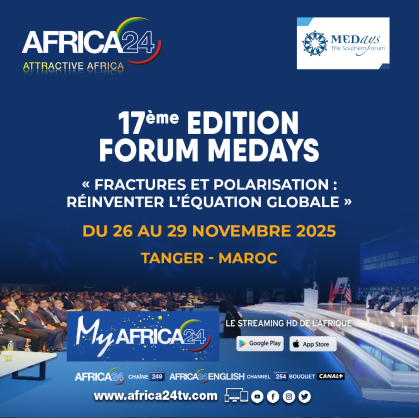
From November 26 to 29, 2025, the AFRICA24 Group (https://Africa24TV.com) will provide exceptional coverage of the 17th edition of the MEDAYS Forum, organised under the High Patronage of King Mohammed VI. This high-level event, which addresses major issues, will be held this year under the theme: Fractures and Polarisation: Reinventing the Global Equation.
The MEDAYS Forum has established itself as a key institution for North-South dialogue and a major meeting place and forum for exchange between global actors in the geostrategic, political, economic and social spheres.
MEDAYS 2025 Forum: A major four-day event:
- 26 November: Official opening ceremony and MEDAYS Awards
- 27–28 November: Official session – Plenary sessions – Round tables
- 29 November: Closing ceremony
About the MEDAYS 2025 Forum:
Organised by the Amadeus Institute in partnership with the MEDays Forum Foundation, MEDAYS 2025 will bring together heads of state, ministers and influential decision-makers around the theme ‘Fractures and polarisation: reinventing the global equation'. Against a backdrop of heightened geopolitical tensions, this edition will welcome more than 7,000 participants from 120 countries, with a particular focus on Africa and the Global South, for more than 50 sessions devoted to international crises, economic change, climate challenges, South-South cooperation and the rise of emerging powers. Defining itself as a space for dialogue and influence, the forum aims to develop concrete solutions for a more inclusive, stable and cooperative multipolar world order, where, according to the organisers, ‘the challenge is no longer just to manage crises, but to reinvent a more balanced global equation'.
The AFRICA24 Group 360° coverage and global broadcasting to 120 million households
Watch ‘MEDAYS Forum 2025' live, on replay and on demand on all your screens at :
- AFRICA24 in French (channel 249) et AFRICA24 English (channel 254) of the Canal+ Africa bundle
- On myafrica24 Africa's first HD streaming platform.
- On https://Africa24TV.com which offers you a full access to all our programmes.
AFRICA24 Group, Transforming Africa Together.
Distributed by APO Group on behalf of AFRICA24 Group.Contact:
Communication Department
AFRICA24 Group
Gaëlle Stella Oyono
Email : onana@africa24tv.com
Tél. : +237 691 30 03 40
Social Media:
@ africa24tv
About the AFRICA24 Group:
Launched in 2009, the AFRICA24 Group is the continent's leading TV and digital media publisher, with four full HD channels broadcast in the major cable packages. A leader among decision-makers and senior executives on the continent, AFRICA24 in French and AFRICA24 English, the Group is the pioneer and leader in African news channels. AFRICA24 has strengthened this leadership through sport with AFRICA24 Sport, Africa's leading channel dedicated to sports news and competitions, and AFRICA24 Infinity, the first channel dedicated to creative industries that showcase the creative genius of African youth in art, culture, music, fashion, design and more.…
The leading audiovisual brand on the continent, the AFRICA24 Group has four full HD television channels, each a leader in its segment :
- AFRICA24 TV : Leading French-language source for African news, published by AMedia
- AFRICA24 English : Leading African news source exclusively in English.
- AFRICA24 Infinity : The creative talent channel dedicated to music, art and culture.
- AFRICA24 Sport : Leading sports and competition news channel.
The AFRICA24 Group publishes myafrica24 (Google store and App Store), the world's first HD streaming platform in Africa available on all screens (television, tablet, smartphone, computers) ... More than 120 million households have access to Africa24 Group channels through major operators such as Canal+, Bouygues, Orange, Bell, etc., and more than 8 million subscribers on various digital platforms and social networks.
Big 5 Global opens in Dubai as industry hails defining era of innovation in construction and urban development

- ‘We have strengthened the readiness of the construction sector by updating regulatory frameworks, enabling the use of environmentally friendly building materials and expanding the adoption of smart technologies,' MoEI tells Big 5 Global Leaders' Summit
- During a panel discussion focused on unlocking the power of geospatial data at the GeoWorld Summit, delegates hear that in Dubai the focus is always on balancing governance with quality of life
- Day one product showcases include agentic AI ecosystems and a graphene-reinforced luxury concrete block with 24-karat gold finish
The 46th edition of Big 5 Global opened its doors today at Dubai World Trade Centre, bringing together international exhibitors, buyers and industry leaders for four days of product showcases, knowledge sharing and on-site collaboration, catering to the region's $9.18 trillion construction projects pipeline (Source: Ventures Onsite). Day one set the pace with active halls, packed sessions and strong participation across all features.
UAE Ministry of Energy and Infrastructure delivers opening keynote
Industry leaders, economists and policymakers converged at the Big 5 Global Leaders' Summit to examine how markets are shifting and what it will take to keep construction supply chains resilient.
Delivering the opening keynote for the summit was His Excellency Eng Yousif Abdalla, Assistant Undersecretary for Federal Infrastructure Projects Sector at UAE Ministry of Energy and Infrastructure, who highlighted how cooperation between public and private sectors remains essential to delivering projects that support economic diversification and national resilience.
“In the United Arab Emirates, we are committed to promoting the adoption of modern technologies in the construction sector and enabling a regulatory and economic environment that keeps pace with this progress,” he said. “We also encourage the use of environmentally friendly building materials, smart construction technologies and advanced data analytics in project management.
“Big 5 Global comes at a critical moment, as countries and institutions move towards smarter cities, more resilient infrastructure and projects that are more efficient in their use of resources and energy. Here, Big 5 Global plays a vital role as a global meeting point that brings together experts, innovators and companies to showcase advanced engineering solutions, exchange expertise and develop partnerships that support the transition toward a more sustainable and adaptable built environment."
‘A defining era of industrial innovation'
In the opening executive dialogue, Asam Hussain, CEO of Arabian Gulf Steel Industries, joined Dr Nicholas Fearnley, Global Head of Construction Forecasting at Oxford Economics, for a candid assessment of the steel industry's outlook. Their conversation addressed global demand trends, the shift towards low-carbon production models, and how locally sourced materials help reduce exposure to geopolitical and economic risks.
“Verified Net Zero steel gives developers' clarity on material choices,” Hussain said. “AGSI's traceable, locally sourced production offers among the lowest-carbon performance globally and supports reliable supply as regional construction needs grow.”
Angela Pernsteiner, Visionary Founder of Würth Professional Solutions, highlighted how transformational leadership and multi-generational business models are shaping new approaches to process efficiency, market positioning and strategic partnerships.
"The Middle East is entering a defining era of industrial innovation, and both the UAE and Würth Professional Solutions share a bold vision for its future,” said Pernsteiner. “With Würth Professional Solutions, we are not just expanding our footprint, we are investing in the region's long-term success.
“The UAE offers a dynamic growth environment, and we bring heritage, global expertise, and applied solutions to unlock its full potential. Our family believes in building solutions that empower industries with precision, reliability, and future-ready engineering. Big 5 Global marks an important milestone in this journey, demonstrating how shared vision and strategic collaboration can drive innovation and lasting impact."
Additional contributions throughout the day came from senior representatives of the Ministry of Public Works and Infrastructure South Africa, King Abdullah Financial District (KAFD), the Italian Trade Agency and Abu Dhabi's DMT and ADPIC, highlighting themes of diversification and long-term planning.
GeoWorld Summit discuss data governance
At the GeoWorld Summit, experts examined governance frameworks for geospatial data and the standards required for responsible use over the next decade. Key topics included data privacy, accuracy, interoperability, regulatory alignment and how AI and machine learning can support better decision-making.
Speaking on a panel session entitled Unlocking the Power of Geospatial Data: A Governance Framework for the Next Decade, Eng Maitha Al Nuaimi, Director of GIS Centre at Dubai Municipality, directly addressed the attending delegates, making it clear that the goal is always to improve the quality of life in the emirate while ensuring data security. Governance, she said, should never negatively affect quality of life, but rather enhance it regardless of whether that is for employees, residents, or visitors.
Eng Heba Matar Khalifa Alnofeli, Head of Asset Registry and Governance Section at Abu Dhabi's Department of Municipalities and Transport (DMT), added that data is fuel and the quality and safety of that data is key.
Product launches and exhibitor highlights
Day one also showcased a range of new products across building materials, smart technologies, tools, HVACR systems and finishing solutions. Exhibitors reported strong engagement from buyers seeking practical solutions that support cost efficiency, sustainability and project delivery.
GIM Black & Gold, exhibiting for the first time, is displaying their graphene-reinforced luxury concrete block with 24-karat gold finish this week. Designed for architectural icons and exclusive projects, Dr Vivek Koncherry, CEO, Graphene Innovations Manchester Ltd, called the launch of GIM Black & Gold Flooring at Big 5 Global “a milestone” for the luxury materials market.
“This patented 24k gold legacy surface delivers true uniqueness, scientific depth, and material excellence, perfectly aligned with the Middle East's drive for innovation and iconic design. To preserve exclusivity, access will be limited.”
Another new-to-market launch comes from Verosoft, a global provider of Enterprise Asset Management (EAM) solutions built on Microsoft Dynamics 365 Business Central. EAM is showcasing its latest innovation, mobiMentor AI, which is an agentic AI ecosystem designed to autonomously execute maintenance tasks, automate workflows, and support technicians with real-time, context-aware insights.
Rounding off the day one product showcases was PlanRadar, a digital platform helping transform construction and real estate workflows by combining task management, reporting, and AI-powered insights. At Big 5 Global 2025, the company is showcasing SiteView 360°, its AI Assistant for automated reporting, reality capture and visual documentation and instant audit-ready reports designed for QA/QC, inspections, and regulatory compliance.
“The opening day of Big 5 Global has certainly set the tone for the 2025 edition, spotlighting how industry transformation and the increasing adoption of technology and artificial intelligence is reshaping the way cities across the world are conceptualized, designed and built,” said Josine Heijmans, Senior Vice President, dmg events.
Big 5 Global runs until Thursday, 27 November, at Dubai World Trade Centre, welcoming industry professionals daily from 10am to 6pm. Registration remains open on-site.
Distributed by APO Group on behalf of dmg events.For media inquiries, please contact:
Deepra Ahluwalia, Action PR
deepra.a@actionprgroup.com
971 56 477 0995
Nour Ibrahim, Action PR
nour.i@actionprgroup.com
971 54 425 0187
Khushie Mallya, PR Executive
Construction, dmg events
khushiemallya@dmgevents.com
Ranju Warrier, Head of PR & Communications
Construction, dmg events
ranjuwarrier@dmgevents.com
About Big 5 Global:
With a 45-year legacy, Big 5 Global is the largest and most influential building and construction event in the Middle East, Africa and South Asia and the annual meeting hub for the global construction industry. Taking place from 24 – 27 November 2025, at the Dubai World Trade Centre, Big 5 Global attracts more than 85,000 global attendees from over 165 countries and 2,800 exhibitors to UAE covering the full construction and urban development cycle across dedicated sectors and nine specialized events enabling industry professionals to source worldwide building solutions for every stage of construction: Heavy, Totally Concrete, Marble & Stone World, Urban Design & Landscape, Windows, Doors & Facades, HVACR World, LiveableCitiesX, GeoWorld and Future FM.
For more information and to register, visit: www.Big5Global.com
African Development Fund commits $14 million grant to scaling up climate resilience across the Sahel

The Board of Directors of the African Development Fund has approved a grant of $14.64 million to support Project 2 of the Programme to Strengthen Resilience to Food and Nutrition Insecurity in the Sahel (P2-P2RS) in Abidjan on 21 November 2025.
The additional financing is provided through the Climate Action Window (http://apo-opa.co/43MyWLA), a climate-focused funding mechanism of the African Development Fund, the concessional lending window of the African Development Bank Group.
The grant aims to strengthen the adaptation and resilience capacities of communities across the Sahel as they face increasingly severe climate extremes. The project adopts a dual approach: scaling up the "climate-smart villages" model around hydro-agricultural infrastructure, and improving access to and use of climate information for decision-making.
The new funding will support the regional seed system by disseminating resilient, high-yielding improved seed varieties. Planned activities include updating the Regional Catalogue of Species and Varieties; creating a business-to-business networking portal; and strengthening seed multiplication capacities of national agricultural research systems and seed companies to ensure availability in climate-smart villages. The project will also support women's and youth empowerment through targeted capacity-building.
In addition, the project will reinforce climate data collection and impact monitoring systems, enhancing real-time data availability from observation networks. It will establish an integrated digital platform for data collection, management, and real-time dissemination, as well as a regional system for monitoring and managing loss and damage data. This includes standardising loss and damage reporting across countries and developing a multi-scale digital platform for the centralised data management.
The Climate Action Window grant will cover 30 municipalities and support the creation of 60 climate-smart villages across Sahelian countries, helping to strengthen community resilience to climate shocks.
Distributed by APO Group on behalf of African Development Bank Group (AfDB).Media contact:
Alexis Adélé
Communication and External Relations Department
media@afdb.org
About the African Development Bank Group:
The African Development Bank Group is Africa's leading development finance institution. It comprises three distinct entities: the African Development Bank (AfDB), the African Development Fund (ADF) and the Nigeria Trust Fund (NTF). Represented in 41 African countries, with a field office in Japan, the Bank contributes to the economic development and social progress of its 54 regional member states. For further information: www.AfDB.org
Eastern Africa Confronts Endemic Foot and Mouth Disease Threat as Regional Stakeholders Validate Long-Term Control Strategy
Download logo
Foot-and-mouth disease (FMD) remains one of the most persistent threats to livestock production, food security, and trade across Eastern Africa. Despite being routinely ranked among the top three priority diseases by governments and livestock keepers, the region continues to experience widespread outbreaks, significant economic losses, and constrained market access due to insufficiently coordinated control measures. The extensive mobility of pastoral herds, porous borders, and limited surveillance and laboratory capacity further complicate containment efforts. Without a harmonised regional approach, national initiatives alone cannot effectively manage the transboundary nature of FMD or mitigate its cascading impacts on livelihoods, nutrition, and national economies.
It is against this backdrop that regional and international stakeholders gathered yesterday in Nairobi for the Consultation and Validation Workshop of the Strategic Framework for the Control of Foot-and-Mouth Disease (FMD) in Eastern Africa 2026–2035. The two-day meeting, held at the Trademark Hotel, Nairobi, brought together representatives from AU-IBAR, IGAD, EAC, FAO, WOAH, UNEP, GALVmed, national Chief Veterinary Officers, FMD focal points, wildlife authorities and technical experts from across the Eastern Africa FMD Roadmap countries.
A Timely Response to an Urgent Regional Challenge
In her opening remarks, Dr. Huyam Salih, Director of AU-IBAR, underscored the scale of the challenge. Livestock underpin food and nutrition security and sustain hundreds of millions of people, yet transboundary animal diseases such as FMD drain billions of dollars from Sub-Saharan Africa each year. Dr. Salih stressed that no single country can manage FMD independently and called for deeper regional coordination, harmonisation, and joint action to address surveillance gaps, strengthen early detection, and ensure rapid response.
She emphasized that the new Strategic Framework provides a necessary mechanism to align national priorities with regional objectives, operationalize shared protocols, and leverage collective capacities. The Framework also responds directly to commitments articulated under Agenda 2063, CAADP (2026–2035), LiDeSA, and the Animal Health Strategy for Africa.
A Strategy Built on Regional Realities and National Inputs
The Strategic Framework for 2026–2035 was developed through extensive consultation, including inputs from the Eastern Africa FMD Roadmap Meeting held in Dar es Salaam in 2024. Delegates highlighted weaknesses such as inadequate vaccination coverage, limited laboratory capabilities for serotyping and vaccine matching, fragmented movement control, and insufficient political commitment and financing for sustained FMD control. These challenges, combined with the region's ecological and socio-economic dynamics, informed the structure of the Framework.
The strategy is anchored on three mutually reinforcing pillars:
- Knowledge and Evidence – establishing regional information-sharing platforms, conducting research, and improving tools for risk assessment, economic analysis, and epidemiological understanding.
- Capacity Building – providing regionally tailored trainings and sourcing essential equipment for surveillance, vaccination, diagnostics, programme management, and public–private partnership models.
- Coordination and Cooperation – harmonising regional protocols, strengthening early warning systems, enhancing rapid response, and facilitating affordable vaccine access through bulk procurement and strengthened laboratory networks.
Collectively, these pillars aim to support countries in progressing along the Progressive Control Pathway for FMD (PCP-FMD) and achieving more secure, efficient livestock systems with improved trade performance.
Deliberations and Validation
Throughout the workshop, participants engaged in structured group work to analyse the draft document, identify gaps, and propose improvements. Presentations on Day 2 allowed country groups to showcase recommendations, including strengthening regional strain monitoring, developing cross-border agreements for sample shipment, institutionalising biosecurity practices in markets and abattoirs, and reinforcing communication strategies to maintain political will.
Plenary discussions refined these inputs and integrated them into the final version of the Framework. The review process reaffirmed the need for pragmatic, risk-based interventions that consider the diverse production systems and varied PCP stages across the 12 roadmap countries.
Looking Ahead
In closing, Dr. Salih reaffirmed AU-IBAR's commitment to supporting Member States and Regional Economic Communities in translating the Framework into concrete action. She noted that the forthcoming rollout of ARIS3 will enhance disease reporting and situational awareness—an essential component of early warning and regional coordination.
With the validation of the Strategic Framework, Eastern Africa has taken a decisive step toward a more structured, collaborative, and evidence-driven approach to FMD control. The region now moves toward developing the implementation plan, mobilising resources, and establishing governance mechanisms to guide the strategy between 2026 and 2035.
By confronting FMD through unified regional action, Eastern Africa strengthens its prospects for improved livestock productivity, enhanced food and nutrition security, resilient livelihoods, and expanded opportunities in domestic and export trade.
Distributed by APO Group on behalf of The African Union – Interafrican Bureau for Animal Resources (AU-IBAR).Nigeria: Renewed Spate of School Kidnappings
Download logo
Nigerian authorities should act urgently to secure the safe release of students and teachers recently kidnapped in the country's northwest and take concrete steps to protect schools and communities from further attacks, Human Rights Watch said today. The groups responsible for the kidnappings should immediately release the students and teachers they are holding captive.
On November 18, 2025, 25 schoolgirls were kidnapped by unidentified armed men from the Government Girls Comprehensive Secondary School in Maga, Kebbi state. Just three days later, on November 21, 303 students and 12 teachers were kidnapped at St. Mary's Catholic Primary and Secondary School in Papiri, Niger state.
“These mass school kidnappings once again lay bare the deliberate targeting of students, teachers, and schools in Nigeria's deteriorating security environment,” said Anietie Ewang, Nigeria researcher at Human Rights Watch. “The deepening crisis underscores the government's failure to protect vulnerable communities.”
No group has claimed responsibility for the attacks. Nigeria has in recent years been plagued by violent attacks and kidnappings by criminal gangs colloquially called “bandits.” These groups have carried out kidnappings for ransom, including of schoolchildren in Nigeria's northwestern and central states. On November 18, the Al-Qaeda-linked Group for the Support of Islam and Muslims (Jama'at Nusrat al-Islam wa al-Muslimeen, or JNIM), which is active throughout the Sahel, claimed responsibility for an attack on a military patrol in Kwara state on October 29, apparently its first incursion into Nigerian territory.
Human Rights Watch spoke with parents of two of the girls abducted in Kebbi state. Isa Nazifi, whose 13-year-old daughter Khadija Nazifi, a junior secondary school student, was among those abducted, said: “I immediately took a motorbike and rushed to the school, where I found my second daughter, also a student at the school. She told me Khadija had been taken. We are extremely worried. My wife is in tears. I will stay here at the school until my daughter returns. If I go home without her, what will I tell my family?”
Malam Sani Zimri, whose daughter, Salima Sani Zimri, is a senior secondary school student who was also abducted, said he had heard rumors from other parents of a possible attack by bandits the week before the incident: “We developed confidence after seeing military operatives surveilling the area, only to realize that there were no security operatives on the premises for the entire three hours that the incident occurred.”
The 2014 Chibok schoolgirls' abduction in Borno state by the armed Islamist group Boko Haram provoked global outrage. Since then, a series of school kidnappings across northern Nigeria has left families traumatized and entire communities living in fear that if their children went to school, they might never return home. In 2016, Human Rights Watch reported that Boko Haram had similarly abducted over 300 children from the Zanna Mobarti Primary School in Damasak, Borno state, in 2015.
In December 2020, more than 300 boys were kidnapped from a boarding school in Kankara, Katsina state. In early 2021, students were again taken in major incidents in Kagara, Niger state, and Jangebe, Zamfara state, followed by the kidnapping of over 100 studentsfrom Bethel Baptist High School in Kaduna state. The spate of kidnappings continued in 2024 with students taken from schools in Kuriga, Kaduna state, and Gidan Bakuso, Sokoto state.
Nigerian authorities have failed to apply lessons from previous attacks to create early warning systems and other measures that could prevent these atrocities, Human Rights Watch said.
In response to the recent kidnappings, the government has promised to rescue the kidnapped students and hold those responsible accountable. President Bola Tinubu directed security agencies to act swiftly to bring the girls back while also urging local communities to share intelligence.
The authorities have also shut down 47 federal secondary schools known as Federal Unity Colleges, and some states including Katsina, Taraba, and Niger have also closed schools or restricted school activities, particularly boarding institutions. While these measures are aimed at protecting students, they have disrupted learning for thousands of children, denying them access to education and the social and psychological support schools provide. Without concrete measures to provide alternative learning opportunities to ensure continuity in their education, the students are at risk of falling behind academically and facing long term setbacks in their development.
Nigeria is a signatory to the Safe Schools Declaration, committing the government to take concrete steps to protect education during conflict and insecurity. Yet kidnappings have continued at a relentless pace and scale. On November 19, the Nigerian Senate ordered a full-scale investigationinto the implementation of the government's Safe School Fund, questioning why money earmarked for protecting schools has failed to prevent recurring attacks. The government should move with urgency to advance a proposal to introduce legislation to implement the Safe Schools Declaration, Human Rights Watch said.
“Children in Nigeria have the right to go to school without fearing for their lives,” Ewang said. “Nigerian authorities should prioritize the safe release of the kidnapped children and their teachers and bring those responsible for their abduction to justice.”
Distributed by APO Group on behalf of Human Rights Watch (HRW).Combating antimicrobial resistance in the poultry value chain through the farmer field schools approach
Download logo
Antimicrobial resistance (AMR) is a natural phenomenon in which micro-organisms such as bacteria, viruses, fungi and parasites develop the ability to survive exposure to antimicrobial agents, rendering medications less effective or ineffective for treating infections. As the world grapples with AMR, the Food and Agriculture Organization of the United Nations (FAO), with support from the Fleming fund grant, and in collaboration with the Government of Zimbabwe, has been implementing Broiler Farmer Field Schools (FFS), an approach aimed at equipping local poultry farmers with knowledge and skills on biosecurity and responsible use of antimicrobials to improve health, productivity and food security.
Last week, FAO in support to the Government of Zimbabwe, facilitated graduation ceremonies for 106 FFS farmers and facilitators in Matabeleland South province. This milestone marks the completion of a two-year programme designed to transform poultry farming practices at community level. The journey began in February 2024, when government and community facilitators underwent a three-week Training of Trainers (ToT) workshop. Following the training, implementation plans were set in motion, starting with farmer identification at ward level, development of locally adapted curricula, and finally, three full cycles of broiler production per FFS.
“The graduation ceremonies are testimony of how broiler FFS specifically serve as participatory hubs of knowledge transfer, equipping farmers with the necessary skills to navigate production while promoting the prudent use of antimicrobials to combat AMR,” said Patrice Talla, FAO Subregional Coordinator for Southern Africa and Representative to Zimbabwe.
The FFS approach emphasizes participatory learning, hands-on demonstrations, and behaviour change, making it a powerful tool for tackling AMR in the poultry value chain. Farmers learn to improve biosecurity, reduce disease risks, and minimize reliance on antibiotics; all aligned with the FAO's Reduce the Need for Antimicrobials on Farms for Sustainable Agrifood Systems Transformation (RENOFARM) initiative, which promotes resilient, sustainable farming systems through innovation and responsible practices.
“For the past two years, this method has helped farmers boost productivity and food security while reducing antimicrobial misuse,” said Tinashe Hodobo, Animal health focal point in the One health secretariat of the government, highlighting the relevance of the FFS approach in curbing AMR.
“For the most part, farmers have learnt how to improve productivity, reduce losses, and enhance food security,” added Hodobo.
Between 2020 and 2022, FAO piloted the FFS approach in broiler production across eight districts in Zimbabwe. In 2023, selected Veterinary Services officers from across Africa, including Zimbabwe, went through the standard FFS master training programme in Kenya, strengthening regional expertise in farmer-led learning.
Following the pilot, FAO established a network of Broiler FFS in four new districts, each serving as a hub for practical training. The rollout included provision of basic Personal Protective Equipment (PPE) for facilitators and farmers during practical sessions, provision of inputs such as feeders, waterers, chicks, feeds and disinfectants and implementation of a structured training programme. Notably, some initial FFS have led to the development of daughter FFS, expanding the reach and impact of the programme.
“When we heard about the Broiler Farmer Field School, we decided to leave our pride and gather wisdom. We've learned how to rear poultry responsibly without relying on antibiotics, and this knowledge is transforming the way we farm,” said Edward Muleya, Vice Chairperson, Fit-Broilers FFS Group in Luthumba Beitbridge.
To ensure sustainability and scalability of the programme, FAO is working with the Community Facilitators and government Veterinary Services and agricultural production specialists who work in the communities, enrolling more participants to the FFS.
“We waited for the practical sessions with hope, and it paid off. Now we have graduated! Today, we're using biosecurity and good management instead of drugs, and the system is working in our villages,” said Nokukanya Jiyane, Government FFS Facilitator in Mangwe district, Matabeleland South Province.
Beyond farmer training, the programme adopts a multi-sectoral approach, strengthening AMR surveillance under the One Health framework. Laboratories across Zimbabwe have been upgraded to improve diagnostic capacity, ensuring early detection and monitoring of antimicrobial resistance.
“Beyond these certificates, what farmers have learned must become a way of life. Scaling up the FFS approach will be key to tackling AMR and building healthier, more productive livestock and agrifood systems,” said Kudzaishe Vhoko-Tapesana, National AMR Coordinator at FAO.
Going forward, FAO plans to build on the success of Broiler FFS by integrating lessons learned into broader agrifood systems initiatives. This will include scaling up FFS to more districts, strengthening linkages with RENOFARM for climate-resilient and sustainable agrifood practices, and deepening AMR surveillance through upgraded laboratories and data-sharing platforms. The aim is to ensure continuity and sustainability, embedding responsible antimicrobial use and biosecurity as pillars of Zimbabwe's agrifood systems transformation.
Distributed by APO Group on behalf of Food and Agriculture Organization of the United Nations (FAO): Regional Office for Africa.