
Merck Foundation Chairman & Chief Executive Officer (CEO) and the First Lady of Zimbabwe Celebrate 7 Years of Long-Term Partnership to Train healthcare providers,...
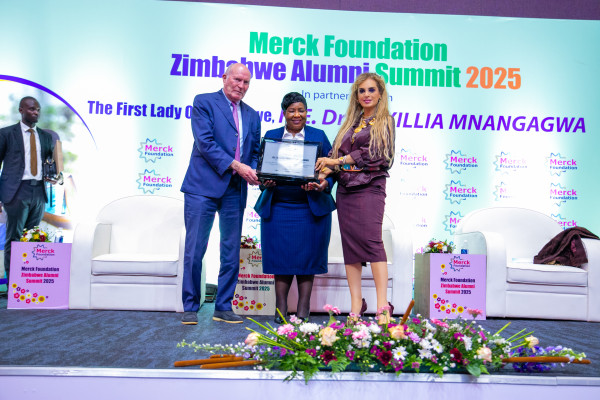
- Merck Foundation marked a milestone of providing 166 scholarships for Zimbabwean doctors in 44 critical specialties during their annual Alumni Summit – Celebrating 7 years of partnership between Merck Foundation and Zimbabwe First Lady and Government, and a remarkable legacy of transforming the country's patient care landscape.
- Merck Foundation Zimbabwe Alumni Summit and Awards Ceremony 2025 was conducted in Harare, chaired by Zimbabwe First Lady and Merck Foundation CEO and Chairman.
- Merck Foundation Chairman and CEO recognized Zimbabwe First Lady for her great efforts as Ambassador of “Merck Foundation More Than a Mother” Campaign.
Merck Foundation (www.Merck-Foundation.com), the philanthropic arm of Merck KGaA Germany conducted the Merck Foundation Zimbabwe Annual Summit and Awards Ceremony 2025 in Harere, Zimbabwe, chaired by The First Lady of Zimbabwe, H.E. Amai Dr. AUXILLIA MNANGAGWA, Chairman of Merck Foundation Board of Trustees, Prof. Dr. Frank Stangenberg-Haverkamp, and CEO of Merck Foundation, Dr. Rasha Kelej.
Senator, Dr. Rasha Kelej (Ret.), CEO of Merck Foundation and President of “More Than a Mother” Campaign emphasized, “It is a great honor to meet my dear sister, H.E. Amai Dr. AUXILLIA MNANGAGWA, First Lady of the Republic of Zimbabwe and to recognize her for her tremendous efforts as the Ambassador of “Merck Foundation More Than a Mother”. We celebrated our seven-year partnership journey and discussed our joint programs to build healthcare and media capacity, empower infertile women, and support girl education. Together, we reflected on our remarkable achievements and marked an important milestone of success and impact since 2018.
I am very proud to share that that we have transformed the patientcare landscape of Zimbabwe by providing 166 scholarships for the local doctors in 44 critical and underserved specialties such as Fertility, Cancer, Diabetes, Cardiology, Endocrinology, Respiratory, Acute Medicine, Sexual and Reproductive care, Embryology, Critical care, Psychiatry, and many more. This is a huge milestone and revolution in patient care across Zimbabwe.
Moreover, it was a pleasure to honor the Zimbabwean winners of Merck Foundation Media Awards 2022 – 2024 and discuss with them the critical role they can play to create a culture shift, be the voice of the voiceless and be the Merck Foundation health and social champions.”
Prof. Dr. Frank Stangenberg Haverkamp, Merck Foundation Board of Trustees emphasized, “Our aim is to improve the overall health and wellbeing of people by building healthcare capacity across Africa, Asia and other developing countries. We are strongly committed to transforming patientcare landscape through our scholarships program.”
H.E. Amai Dr. AUXILLIA MNANGAGWA, First Lady of the Republic of Zimbabwe and the Ambassador of “Merck Foundation More Than a Mother” expressed, “It is a great pleasure to welcome and meet the Chairman and CEO of Merck Foundation in our country. Together we celebrated an important milestone of the great success of our joined programs and also shared the impact of our 7-year partnership journey that we have with Merck Foundation to build healthcare capacity, transform patientcare, break infertility stigma and support girl education in our country since 2018.
In a very short time, Merck Foundation has provided 166 scholarships for our young doctors in many specialties which are very critical for us. Moreover, together we are providing annual scholarships to support the education of 40 high-performing yet underprivileged schoolgirls, till they graduate, as a part of the Educating Linda Program. This is for the first time that we work on such an impactful program, it is history in the making.”
Merck Foundation has provided more than 2400 scholarships for healthcare providers from 52 countries in 44 critical and underserved medical specialties.
Out of the total 166 scholarships provided in Zimbabwe, Merck Foundation has provided:
- 60 scholarships for doctors in Diabetes, Endocrinology, Cardiology, Cardiovascular Preventive, and Obesity & Weight Management. This represents a significant number of experts in the public healthcare system addressing the lifestyle-related health issues that are on the rise in our country and the rest of Africa.
- 48 scholarships have been provided for Fertility, Embryology, and the one-year diploma and two-year master's degree programs in Sexual & Reproductive Care, Women's Health, Family Medicine and Psychiatry.
- 58 scholarships have been provided for critical yet underserved specialties, including Oncology and Cancer care, Respiratory Care, Acute Medicine, Pain Management, Infectious Diseases, Dermatology, Psychiatry, Neurosurgery, Neurology, Neuroimaging for Research, Pediatrics, Gastroenterology, Orthopedics, Critical Care, Care for Older Person and Rheumatology.
During the Summit, Merck Foundation Awards Ceremony was held, during which 13 Winners of the Merck Foundation Awards were acknowledged by Merck Foundation Chairman, Merck Foundation CEO together with Zimbabwe First Lady. Merck Foundation has so far celebrated more than 60 winners of the Media, Song, Film, and Fashion Awards, since 2017.
The beneficiaries of the Educating Linda program were also present at the Summit, where a few of them shared inspiring testimonies on how the scholarships have changed their lives.
“I really believe that when the girls are educated, their countries become more powerful, stronger & prosperous”, added Senator Kelej.
Merck Foundation in partnership with The First Lady of Zimbabwe has launched eight children's storybooks, “More Than a Mother”, ‘Educating Rujeko”, “Make the Right Choice”, “Jackline's Rescue”, “Not Who You Are”, “Ride into the Future”, “Sugar free Jude” and “Mark's Pressure”. These books address critical social and health issues to young children. Thousands of copies of these storybooks have been distributed to schoolchildren, several more are going to be distributed soon.
Moreover, Merck Foundation has conducted six editions of their Health Media Training for the Zimbabwean journalists in order to empower them to raise awareness about sensitive issues like breaking infertility stigma, supporting girl education, stopping GBV, ending Child marriage and FGM and raise awareness about diabetes and hypertension prevention and early detection.
Merck Foundation in partnership with The First Lady of Zimbabwe has also announced the Call for Application for their 8 important Awards for Media, Musicians, Fashion Designers, Filmmakers, students, and new potential talents in these fields.
Details of the Awards:
1. Merck Foundation Africa Media Recognition Awards “More Than a Mother” 2026: Media representatives and media students are invited to showcase their work to raise awareness about one or more of the following social issues such as: Breaking Infertility Stigma, Supporting Girl Education, Women Empowerment, Ending Child Marriage, Ending FGM, and/ or Stopping GBV at all levels.
Submission deadline: 30th September 2026.
2. Merck Foundation Film Awards “More Than a Mother” 2026: All African Filmmakers, Students of Film Making Training Institutions, or Young Talents of Africa are invited to create and share a long or short FILMS, either drama, documentary, or docudrama to deliver strong and influential messages to address one or more of the following social issues such as: Breaking Infertility Stigma, Supporting Girl Education, Women Empowerment, Ending Child Marriage, Ending FGM, and/ or Stopping GBV at all levels.
Submission deadline: 30th September 2026.
3. Merck Foundation Fashion Awards “More Than a Mother” 2026: All African Fashion Students and Designers are invited to create and share designs to deliver strong and influential messages to raise awareness about one or more of the following social issues such as: Breaking Infertility Stigma, Supporting Girl Education, Women Empowerment, Ending Child Marriage, Ending FGM, and/ or Stopping GBV at all levels.
Submission deadline: 30th September 2026.
4. Merck Foundation Song Awards “More Than a Mother” 2026: All African Singers and Musical Artists are invited to create and share a SONG with the aim to address one or more of the following social issues such as: Breaking Infertility Stigma, Supporting Girl Education, Women Empowerment, Ending Child Marriage, Ending FGM, and/ or Stopping GBV at all levels.
Submission deadline: 30th September 2026.
5. Merck Foundation Media Recognition Awards 2026 “Diabetes & Hypertension”: Media representatives are invited to showcase their work through strong and influential messages to promote a healthy lifestyle and raise awareness about the prevention and early detection of Diabetes and Hypertension.
Submission deadline: 30th October 2026.
6. Merck Foundation Film Awards 2026 “Diabetes & Hypertension”: All African Filmmakers, Students of Film Making Training Institutions, or Young Talents of Africa are invited to create and share a long or short FILMS, either drama, documentary, or docudrama to deliver strong and influential messages to promote a healthy lifestyle raise awareness about prevention and early detection of Diabetes and Hypertension.
Submission deadline: 30th October 2026.
7. Merck Foundation Fashion Awards 2026 “Diabetes & Hypertension”: All African Fashion Students and Designers are invited to create and share designs to deliver strong and influential messages to promote a healthy lifestyle and raise awareness about the prevention and early detection of Diabetes and Hypertension.
Submission deadline: 30th October 2026.
8. Merck Foundation Song Awards 2026 “Diabetes & Hypertension”: All African Singers and Musical Artists are invited to create and share a SONG with the aim to promote a healthy lifestyle and raise awareness about the prevention and early detection of Diabetes and Hypertension.
Submission deadline: 30th October 2026.
Entries for all the awards are to be submitted via email to: submit@merck-foundation.com
Distributed by APO Group on behalf of Merck Foundation.Contact:
Mehak Handa
Community Awareness Program Manager
Phone: +91 9310087613/ +91 9319606669
Email: mehak.handa@external.merckgroup.com
Join the conversation on our social media platforms below and let your voice be heard!
Facebook: https://apo-opa.co/44WFYxD
X: https://apo-opa.co/44nz4RZ
Instagram: https://apo-opa.co/4pz1tNp
YouTube: https://apo-opa.co/4pyDD4e
Flickr: https://apo-opa.co/44oPF7W
Website: www.Merck-Foundation.com
Download Merck Foundation App: https://apo-opa.co/3Mx697Q
About Merck Foundation:
The Merck Foundation, established in 2017, is the philanthropic arm of Merck KGaA Germany, aims to improve the health and wellbeing of people and advance their lives through science and technology. Our efforts are primarily focused on improving access to quality & equitable healthcare solutions in underserved communities, building healthcare and scientific research capacity and empowering people in STEM (Science, Technology, Engineering, and Mathematics) with a special focus on women and youth. All Merck Foundation press releases are distributed by e-mail at the same time they become available on the Merck Foundation Website. Please visit www.Merck-Foundation.com to read more. Follow the social media of Merck Foundation: Facebook (https://apo-opa.co/44WFYxD), Twitter (https://apo-opa.co/44nz4RZ), Instagram (https://apo-opa.co/4pz1tNp), YouTube (https://apo-opa.co/4pyDD4e) and Flickr (https://apo-opa.co/44oPF7W).
Nigeria Sets the Stage for Global Regulatory Technology Leadership as 2026 RegTech Africa Conference & Expo Heads to Abuja
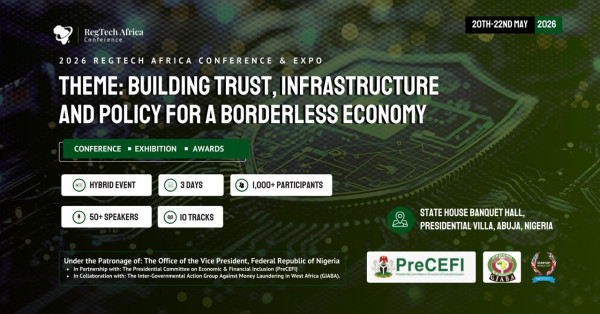
Under the distinguished patronage of the Office of the Vice President, Federal Republic of Nigeria, and in partnership with the Presidential Committee on Economic & Financial Inclusion (PreCEFI), with the collaboration of the Inter-Governmental Action Group against Money Laundering in West Africa (GIABA), the 2026 RegTech Africa Conference & Expo (https://RegTechAfrica.com) will convene global leaders in policy, finance, and technology from 20th to 22nd May 2026 at the State House Banquet Hall, Abuja, Nigeria.
Anchored on the theme, “BUILDING TRUST, INFRASTRUCTURE AND POLICY FOR A BORDERLESS ECONOMY,” the conference is positioned as a premier global platform for shaping the future of trusted digital financial systems, cross-border trade, and regulatory innovation.
The event will bring together heads of government and regulatory agencies, central banks, financial intelligence units, multinational financial institutions, technology leaders, investors, and policy architects to align strategy around the infrastructure, governance, and digital trust frameworks required to unlock Africa's full participation in the global digital economy.
“Regulatory technology is no longer optional. It has become the backbone of secure, inclusive, and sustainable economic systems. The 2026 RegTech Africa Conference & Expo represents Nigeria's commitment to leadership in shaping global standards for trust, transparency, and cross-border economic collaboration,” Cyril Okoroigwe, Chair Organizing Committee.
A central highlight of the event will be the hosting of the prestigious Global Startup World Cup Tournament – Regional Challenge, providing African startups with a world-class stage to pitch their solutions before an international panel of judges, venture capitalists, and industry experts. Winners of the regional challenge will proceed to compete at the grand finale in Silicon Valley, for a $1,000,000 investment prize, unlocking access to global investors, accelerators, and strategic partnerships.
“By bringing the Startup World Cup Regional Challenge to Abuja, we are not only showcasing African innovation, but connecting it directly to global capital, mentorship, and markets,” Graham Olasukanmi Lawal, Director Partnerships, Regtech Africa.
The three-day event, which provides strategic platform for dialogue, innovation, and collaboration will feature strategic ministerial dialogues, closed-door executive roundtables, investment-focused breakout sessions, technology showcases, and curated networking platforms designed to foster impactful public–private partnerships.
Sponsorship and Strategic Partnership Opportunities
Public and private sector organizations, multinational corporations, development finance institutions, technology firms, and venture funds are invited to participate as strategic sponsors and partners. Curated partnership opportunities are available across policy leadership, infrastructure development, innovation acceleration, and market expansion pillars.
“This is a rare opportunity for forward-looking institutions to align their brands with the future of regulation, trust infrastructure, and borderless digital commerce in Africa and beyond,” Mr. Lawal noted.
The conference is expected to attract thousands of participants from across Africa, Europe, the Middle East, Asia, and North America.
Registration & Partnership Opportunities Now Open
To explore partnership opportunities or register interest, please contact: info@regtechafrica.com
For further details, visit: www.RegTechAfricaConference.com.
About RegTech Africa:
RegTech Africa is a leading authority advancing the adoption of regulatory technology and digital trust infrastructure across the African continent. Through world-class conferences, research, and multi-stakeholder collaborations, RegTech Africa fosters innovation that strengthens financial stability, accelerates inclusion, and enhances regulatory excellence.
African Development Bank Group approves $76.3 million in additional financing to advance transport connectivity in the Horn of Africa

The Board of Directors of the African Development Bank Group (www.AfDB.org) has approved $76.37 million in additional financing for the Road Infrastructure Programme in Somalia, a key component of the Horn of Africa corridor project linking Somalia, Djibouti and Ethiopia.
The new funding package comprises $49.16 million from the African Development Fund, the Bank Group's concessional lending window, and $27.21 million from the Transition Support Facility, which supports countries experiencing fragility and conflict.
The Programme aims to improve transport connectivity within Somalia, and between the country and its neighbours in the Horn of Africa. It is designed to stimulate cross-border trade, strengthen regional integration and reduce fragility within the region.
Mike Salawou, the Bank Group's Director of Infrastructure and Urban Development, noted that the request for additional financing stems from an expansion of the project's initial scope. “The Programme has evolved from minimal interventions to full road upgrades, enabled by improved designs and the integration of new components, including bridges, additional road sections, and trade facilitation measures, social infrastructure to maximize the benefit for the local community” he said.
The financing will primarily upgrade two strategic road sections: a 15-kilometre stretch connecting Zeila to Asha Addo in Somaliland, and a 22-kilometre section from Beled Weyne to Kalabeyr in Hirshabelle State.
In addition to road works, the project includes targeted community development and resilience initiatives. These will improve access to essential services through the construction of boreholes, the refurbishment of classrooms to serve as skills development centres, the construction of markets and storage facilities, and the rehabilitation of health centres.
To further support economic activity, the Programme will facilitate cross-border trade, strengthen support for small traders, and enhance institutional capacities in customs and trade management. Key interventions include establishing a simplified trade regime between Somalia and Ethiopia for small-scale operators and expanding Somalia's automated customs system to streamline and modernise customs procedures.
Distributed by APO Group on behalf of African Development Bank Group (AfDB).Media contact:
Alexis Adélé
Communications and External Relations Department
media@afdb.org
About the African Development Bank Group:
The African Development Bank Group is Africa's premier development finance institution. It comprises three distinct entities: the African Development Bank (AfDB), the African Development Fund (ADF) and the Nigeria Trust Fund (NTF). Represented in 41 African countries, with an external office in Japan, the Bank contributes to the economic development and social progress of its 54 regional member states. For more information: www.AfDB.org
The Government of Angola Launches an International Public Tender for the Management of the Namibe Corridor

The Ministry of Transport of The Republic of Angola (www.MinTrans.gov.ao) has today launched, 5th December, the Public Tender for the Concession of the Right to Operate, Manage and Maintain the Namibe Corridor. Interested entities may submit their proposals until 4 May 2026.
The concession, with an initial duration of 30 years, extendable up to 50 years, covers the operation, management, maintenance and preservation of the Moçâmedes–Menongue Railway Line, including rolling stock, associated infrastructure, workshops and the training centre. It further encompasses the possibility of designing and constructing new sections, extensions and branch lines, as well as railway connections to the Republic of Namibia and, at a later stage, to the Republic of Zambia.
The Secretary of State for Land Transport, Jorge Bengue, noted at the launch event that the process constitutes a strategic opportunity for international operators with a proven track record in the railway sector. “The Namibe Corridor has the potential to strengthen Angola's role as a regional logistics platform, enhance supply chains, foster new investments, and increase the competitiveness of exports. We anticipate a dynamic tender process with strong participation from established industry operators,” he stated.
Jorge Bengue further emphasised that Angola has carried out structural reforms in recent years that have strengthened legal certainty and created a more competitive business environment. The success of the concession of the Lobito Corridor has demonstrated the country's capacity to implement partnership models that stimulate private investment and accelerate the modernization of transport infrastructure.
Individual companies or consortiums of competitors with proven experience in the management of railway infrastructure and freight operations are eligible to apply. The detailed technical and financial requirements are set out in the tender documents, which are available for a fee of USD 20,000, or the equivalent in kwanzas at the exchange rate of the National Bank of Angola at the time of the transaction.
The Namibe Corridor encompasses the Moçâmedes Railway, with a total length of 855 km, and the Port of Namibe, forming a strategic logistics axis for the export of minerals, ornamental stones, agricultural products, and other goods. The infrastructure allows for a theoretical capacity of up to 5 million tonnes per year, serving as a connection point for landlocked countries in the region, in coordination with the Lobito and Walvis Bay corridors.
This corridor also contributes to tourism development and regional integration, strengthening Angola's position in Atlantic–Indian trade routes and consolidating the country as a significant commercial hub within the African context.
Distributed by APO Group on behalf of Ministry of Transport of Angola.The African Development Fund grants Guinea nearly $26 million in additional funding to develop an electricity interconnection with Mali

The Board of Directors of the African Development Fund approved additional financing of $25.79 million for Guinea for the 225 kV Guinea-Mali electricity interconnection project.
The financing, agreed in Abidjan on 10 December 2025, from the African Development Bank Group's concessional window includes a loan of approximately $22 million and a grant of $3.79 million to Guinea.
The project will contribute to the socioeconomic development of Guinea and Mali by providing inhabitants with better access to high-quality, low-cost energy.
The additional financing will support the continued implementation of the project, initially funded with approximately $41 million from the African Development Fund in December 2017. It will raise the total project cost in Guinea from $346 million to $372 million. Alongside the Fund's contribution, the project is co-financed by the European Union, the World Bank, the European Investment Bank and the ECOWAS Bank for Investment and Development (EBID). The implementation period will run from January 2026 to December 2028.
The new resources will enable the installation of 37,500 additional electricity connections. The project also includes the development of medium-voltage feeders at HV/LV substations to support rural electrification, as well as institutional assistance for key national bodies, including Électricité de Guinée (EDG) and the Electricity and Water Regulatory Authority (AREE). It will also cover the operating costs of the Management Unit and the consulting engineer. This intervention will help strengthen governance and increase electricity access—two persistent challenges for the sector. In 2024, national access stood at just 52 percent, with stark differences between urban areas (89 percent) and rural areas (21 percent).
The project will directly benefit households by improving living conditions, as well as essential socio-economic infrastructure such as schools, health centres, artisanal workshops and women's groups. Productive users will gain access to reliable electricity to expand their activities. Strengthening these structures will boost employment, reduce poverty and enhance social cohesion.
Distributed by APO Group on behalf of African Development Bank Group (AfDB).Media contact:
Aissatou Diallo
Communications and External Relations Department
media@afdb.org
About the African Development Bank Group:
The African Development Bank Group is Africa's leading development finance institution. It comprises three distinct entities: the African Development Bank (AfDB), the African Development Fund (ADF) and the Nigeria Trust Fund (NTF). Represented in 41 African countries, with a field office in Japan, the Bank contributes to the economic development and social progress of its 54 regional member states. For more information: www.AfDB.org