
Explore more Articles in
Sustainability
Sonatrach-Ghana National Petroleum Corporation (GNPC) Research and Development (R&D) Partnership Signals Africa’s Energy Future is Innovation-Led

Download logo
Algeria's state-owned oil company Sonatrach and the Ghana National Petroleum Corporation (GNPC) have signed a Memorandum of Understanding (MoU) under the auspices of the African Petroleum Producers Organization (APPO), formalizing plans for a strategic partnership focused on research, development and innovation (R&D) in the oil and gas sector. Signed in Brazzaville, the Republic of Congo - the headquarters of APPO - and in the presence of APPO's recently appointed Secretary General Farid Ghezali, the MoU establishes a framework for assessing joint opportunities, sharing expertise and creating structured working mechanisms to support the development of hydrocarbon resources for energy security and sustainable development across Africa.
The African Energy Chamber (AEC) welcomes the agreement and expresses its full support for Sonatrach and GNPC in advancing African-led R&D collaboration. The agreement signifies APPO as not only an instrumental part in facilitating the partnership but a central force in bringing all parties together to ratify this important deal. Under the leadership of Ghezali, APPO continues to showcase its commitment to unifying nations - as well as the broader industry - to reach decisive agreements such as this one. The partnership also reflects a growing recognition among national oil companies (NOC) that innovation, technology and knowledge-sharing are essential to unlocking value, reducing costs and ensuring Africa remains competitive in a rapidly evolving global energy market. The AEC believes that this collaboration is expected to move the entire industry into its next phase of development.
The scope of cooperation outlined in the MoU is both comprehensive and forward-looking. It includes advanced onshore and offshore seismic technologies such as high-definition processing and interpretation, artificial intelligence-enabled subsurface analysis, 4D seismic and real-time reservoir modeling. The agreement also covers digital wells and digital oilfields, enhanced and improved oil recovery, stratigraphic exploration objectives, integrity and corrosion management and oil and gas valorization - capabilities that directly improve recovery rates, extend the life of producing assets and maximize returns from existing infrastructure. The partnership also integrates energy transition and environmental priorities alongside core upstream development. Areas of cooperation include carbon footprint reduction, low-carbon industrial solutions, hydrogen and green technologies, as well as water and waste treatment and air pollution mitigation. This reflects a pragmatic African approach: developing hydrocarbons responsibly while embedding sustainability and emissions management into project design and operations from the outset.
The agreement comes at a critical time for both markets. For Ghana, the MoU signals a commitment to leveraging innovation to revitalize oil production as the nation looks to revive oilfields, diversify the industry through gas and support broader regional energy growth. With 17 oil and gas projects scheduled for development by 2027, Ghana is working to expand exploration, ramp up production and deepen private sector participation. Recent milestones point to a strong resurgence across the market. Just this month, Kosmos Energy announced that it successfully drilled and completed the J-74 well - part of the larger 2025-2026 Jubilee field development campaign. In partnership with the GNPC and Tullow, the company plans to drill 20 wells at Jubilee under a $2 billion upstream expansion plan, five of which are planned for 2026. Alongside oil Ghana is advancing gas developments under efforts to monetize its over 2.1 trillion cubic feet of available resources. Projects such as a planned second processing plant - with a capacity of 150 million standard cubic feet per day - are underway and will complement operational facilities such as the Atuabo Plant.
As one of Africa's biggest oil and gas producers, Algeria is well-positioned to support Ghana's hydrocarbon goals. The country is advancing its own ambitious hydrocarbon strategy, anchored by a five-year plan endorsed by Sonatrach that will mobilize up to $60 billion in investment. The program prioritizes sustained exploration and production to offset natural decline, alongside the modernization and expansion of downstream infrastructure to strengthen value addition, boost export capacity and enhance long-term energy security. Through this strategy, Algeria is reinforcing its role as a continental energy leader while generating technical expertise and operational know-how that can be leveraged through partnerships with peers such as GNPC. By prioritizing R&D, embracing technology and aligning hydrocarbons development with sustainability objectives, Sonatrach and GNPC are setting a strong precedent. The AEC commends both companies and APPO for advancing an African-led model that supports energy security, economic growth and sustainable development across the continent.
“APPO continues to showcase a commitment to advancing Africa's hydrocarbon development. This MoU shows that African NOCs are investing in innovation to secure the continent's energy future. Research and technology are critical to producing oil and gas more efficiently and sustainably, while supporting the broader energy transition. Africa needs oil and gas to develop, and partnerships like this ensure those resources deliver long-term value for our people,” stated NJ Ayuk, Executive Chairman, AEC.
Distributed by APO Group on behalf of African Energy Chamber.Kenya Engineer Releases Volume 54, Issue 1 (January–February 2026), Now in Circulation
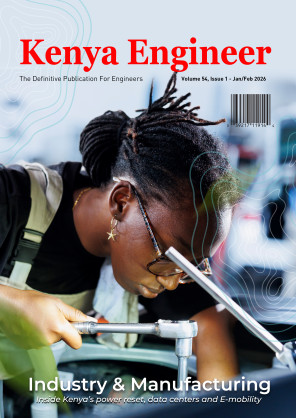
Kenya Engineer Magazine (www.KenyaEngineer.co.ke) has released the January–February 2026 issue, marking the first issue of Volume 54 and reaffirming the publication's long-standing role as a trusted platform for engineering insight in Kenya, East Africa, and beyond.
For more than five decades, Kenya Engineer has documented the evolution of engineering practice, industry, and policy across the region. The latest issue is published at a time when engineering is increasingly central to energy transition, industrial growth, infrastructure development, and sustainability, and it continues the magazine's commitment to professionally grounded, context-driven content.
Focus of the January–February 2026 Issue
The new issue brings together analysis, interviews, and features examining key developments shaping the engineering and industrial landscape, including:
- Power and energy sector developments and their implications for industry
- Grid stability, transmission, and infrastructure readiness
- Manufacturing and industrialisation in Kenya and across Africa
- Engineering leadership, policy alignment, and skills development
- Emerging trends in sustainability and electric mobility
Rather than reporting events in isolation, the issue places emphasis on context, relevance, and long-term implications, offering insight that remains valuable to professionals, institutions, and decision-makers beyond the news cycle.
A Trusted Platform for the Engineering Ecosystem
Kenya Engineer continues to serve a diverse readership that includes practicing engineers, technical managers, utilities, manufacturers, EPC firms, regulators, policymakers, and academic institutions. Its positioning as a credible, independent platform has made it a reference point for industry dialogue and professional reflection across the region.
As engineering challenges grow more complex and interconnected, the publication remains focused on supporting informed discussion that links engineering practice, industry needs, and development priorities.
Availability
The January–February 2026 issue is now in circulation and is available in both print and digital formats, ensuring accessibility for readers locally and internationally. In addition to individual copies, annual print subscriptions covering six issues are also available for professionals, firms, and institutions that rely on Kenya Engineer as a reference publication.
Digital download link - https://apo-opa.co/3N0wueV
Print copy order - https://apo-opa.co/3Yrurmw
Distributed by APO Group on behalf of The Kenya Engineer.For further information:
www.KenyaEngineer.co.ke
info@kenyaengineer.co.ke
admin@kenyaengineer.co.ke
About Kenya Engineer:
Kenya Engineer is a professional engineering magazine serving East Africa and beyond. It provides news, analysis, and features across power, infrastructure, manufacturing, automation, sustainability, and emerging technologies, with a focus on engineering-led development. The publication has served the engineering community for over 50 years.