
Explore more Articles in
Employment
Appointment of the Chief Executive Officer of the Seychelles National Youth Council

Download logo
The Office of the President has today announced the appointment of Mr. Michel Raymond Pierre as the new Chief Executive Officer of the Seychelles National Youth Council (SNYC), with effect from 1 January 2026.
Mr. Pierre brings extensive experience in youth development, governance, stakeholder engagement, and programme management. He has worked closely with national and regional partners on youth empowerment initiatives and has demonstrated strong leadership in managing complex programmes, mobilising resources, and strengthening institutional frameworks. His background includes hands-on involvement in youth policy implementation, grants and programme management, and collaboration with civil society organisations.
Following his transfer from employment as a youth worker, Mr. Pierre served at the Citizens Engagement Platform (CEPS) from 2014 to 2021, initially as Events and Programmes Manager, and subsequently, from 2017, as Chief Executive Officer.
At the time of his appointment as Chief Executive Officer of SNYC, Mr. Pierre was serving as Grants Coordinator at the Seychelles Conservation and Climate Adaptation Trust (SEYCCAT).
Distributed by APO Group on behalf of State House Seychelles.MIR Holding: Mouhamad Dieng and President Adama Borrow lay the groundwork for collaboration
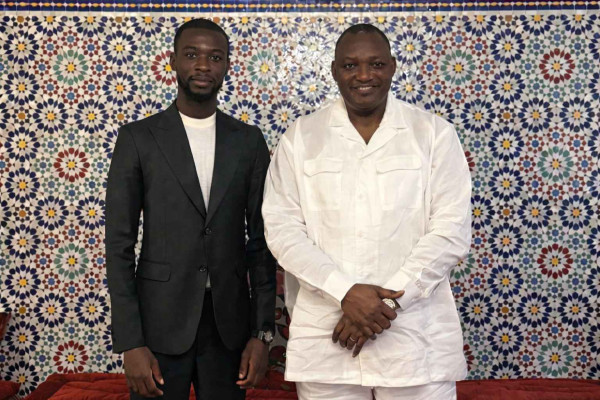
MIR Holding (https://MIRHolding.Odoo.com), a global investment group, is exploring potential investments in The Gambia after its Chief Executive Officer, Mouhamad Dieng, held talks with His Excellency President Adama Barrow.
The meeting focused on the role of private investment in supporting economic growth, improving infrastructure and strengthening key productive sectors, as the Gambian government seeks to attract long-term capital to diversify its economy.
MIR Holding identified several sectors of interest, including digital infrastructure and urban infrastructure, real estate and tourism. These sectors are central to The Gambia's development strategy, given their potential to boost productivity, employment and foreign investment.
According MIR Holding's guiding principles, any potential investment would be subject to due diligence and structured in close coordination with public authorities and local partners. The group emphasised governance, regulatory clarity and long-term project viability as key criteria in its investment decisions.
Digitalisation was discussed as a cross-cutting priority, with a focus on strengthening digital infrastructure and improving service delivery. Infrastructure development was also highlighted as a prerequisite for enhancing connectivity and supporting private sector growth.
Real estate and tourism were also identified as areas with significant upside potential, particularly projects aligned with global standards and sustainability principles, while responding to local market needs.
“Governance and policy predictability were central to the discussions. Investors require clear regulatory frameworks and institutional stability to commit long-term capital, MIR Holding's CEO Mouhamad Dieng noted.
“Public-private dialogue is critical to building investor confidence and this visit to The Gambia is part of MIR Holding's broader pan-African strategy to expand its footprint across the continent while aligning investments with national development agendas.” He added.
The group operates across investment, real estate, services and infrastructure, and positions itself as a long-term partner rather than a short-term financial investor.
MIR Holding and Gambian authorities are expected to continue technical discussions in the coming months to assess specific project opportunities and partnership structures, the sources said.
Distributed by APO Group on behalf of MIR Holding.Press contact :
Elisabeth TINE
Communication officer
contact@brainz-sn.com
Tel. 00 33 843 99 47
About MIR Holding:
MIR Holding is a global investment group with operations across several strategic sectors, including investment, real estate, services and infrastructure. The group focuses on long-term value creation, governance and sustainable impact, working in partnership with public and private stakeholders. MIR Holding aims to contribute to Africa's economic transformation by developing projects aligned with national priorities and international investment standards.
African Energy Chamber (AEC) Voices Support for Venezuela, Emphasizing Stability as the Gateway to Energy Recovery and Long-Term Growth
Download logo
Venezuela enters 2026 amid heightened uncertainty following the detention of the country's president by the United States and the subsequent announcement by the supreme court that Delcy Rodríguez has assumed the role of Acting President. These developments have placed renewed focus on the importance of institutional continuity and stability at a moment when Venezuela's economic and energy future hangs in the balance.
For the African Energy Chamber (AEC), stability remains the single most critical requirement for development. Venezuela holds the largest proven oil reserves in the world, a resource base with the potential to transform the country's economic trajectory, rebuild infrastructure and restore energy security. Realizing this potential, however, will depend on predictable governance, responsible resource management and the creation of mutually beneficial contractual frameworks that encourage long-term investment. At this critical juncture, the AEC calls on the energy industry and the international community to provide maximum support to Acting President Rodríguez, encouraging unity, institutional continuity and a nationally driven development agenda.
“This is the time to continue encouraging everyone to invest in Venezuela. We call on African states and leaders as well as the Global South to give the Acting President and the Venezuelan people support as they determine their future, sovereignty and how they want to proceed,” stated NJ Ayuk, Executive Chairman, AEC.
The AEC has long-held a strong working relationship with both Acting President Rodríguez and Venezuela at large. For her part, Acting President Rodríguez - who also serves as Oil Minister - has long-supported Africa's right to use its oil resources to better the lives of its people. Under her leadership, the country - through its state-owned PDVSA - has developed strong international ties with Africa. Looking ahead, the Chamber believes that the Global South stands to benefit from continued multilateral, respectful engagement.
Importantly, Venezuela is not isolated from the Global South's energy dialogue. As a founding member of OPEC, Venezuela has spearheaded the inclusion of African countries in the organization, recognizing their role in stabilizing global energy markets. Meanwhile, as an Honorary Member of the African Petroleum Producers' Organization, the country has long recognized the value of South-South cooperation, shared technical expertise and collective approaches to resource development. This relationship underscores Venezuela's alignment with producer nations that view hydrocarbons not as a liability, but as a development tool capable of driving industrialization, energy security and social progress when managed responsibly.
Beyond that, Venezuela continues to lead capacity building programs with African companies and students. The country trains African students, fosters leadership development and opens opportunities for African companies to invest in the country - not only in energy but various other sectors.
For Venezuela, oil remains the backbone of the economy and the most powerful lever available to accelerate recovery. Even after years of decline, hydrocarbons still account for close to 90% of export revenues and more than half of government income, while contributing an estimated 17% to 20% of GDP. Venezuela holds the world's largest proven oil reserves at approximately 303 billion barrels, representing around 17% of global reserves. At current and projected oil prices, the in-ground notional value of these resources is measured in the tens of trillions of dollars, placing Venezuela among the most strategically significant energy geographies in the world.
Production realities, however, highlight both the scale of the challenge and the opportunity ahead. After collapsing to roughly 300,000 barrels per day (bpd) in 2020, output has recovered to approximately 900,000 to 1.1 million barrels per day as of early 2026. This remains far below the historical peak of 3.4 million bpd reached in the late 1990s, but it demonstrates that Venezuela's industry is not irreparably damaged. With stable governance, regulatory clarity and sustained investment of around $10 billion per year, production in the country has the potential to reach 2.5 million bpd over the next decade, with a return to peak levels requiring cumulative investment in the range of $80 billion to $100 billion.
The heart of this recovery lies in the Orinoco Heavy Oil Belt, which covers some 55,000 km2 and contains nearly 90% of Venezuela's reserves. Blocks such as Petropiar, Ayacucho and the Zuata Complex anchor current output, though the extra-heavy nature of the crude means that access to dilutants, upgrading capacity and modern technology will be essential. Alongside oil, offshore natural gas presents an important diversification opportunity. Projects such as the Dragon field, estimated to hold more than 4 trillion cubic feet of gas, and the Cocuina-Manakin development near Trinidad offer pathways to monetize gas through regional LNG markets, support power generation and reduce the economy's overreliance on crude exports.
Infrastructure rehabilitation will be equally critical. Venezuela's refining system, with nameplate capacity of around 1.46 million bpd, is operating at just 10% to 20% due to decades of deferred maintenance. Pipelines, many of them more than 50 years old, require billions of dollars in upgrades, while the country's state-owned Petróleos de Venezuela, S.A. estimates total infrastructure needs of roughly $58 billion to restore functionality across the value chain. These investments have the potential to become employment engines and confidence signals that can rapidly improve domestic economy conditions.
International participation, mutually-beneficial investment terms, transparency and local involvement will be indispensable in this process. Existing involvement by companies such as Chevron, which currently produces around 240,000 to 250,000 bpd through joint ventures, illustrates the catalytic role that experienced operators can play. European firms including Eni, Repsol and Shell, alongside service providers such as SLB, Baker Hughes and Halliburton, have maintained a presence focused on asset integrity and selective growth under constrained conditions. By evolving into mutually-beneficial contracts, these relationships can form the backbone of a broader re-engagement by the global energy industry.
“Venezuela sits atop extraordinary natural wealth, and the lesson from Africa is clear: when stability is prioritized and the energy sector is allowed to function responsibly, hydrocarbons can drive recovery, unity and long-term development. The industry and the international community must come together at this critical moment,” concluded Ayuk.
Distributed by APO Group on behalf of African Energy Chamber.Eritrea: National Confederation of Eritrean Workers (NCEW)-Meeting on action plan for 2026
Download logo
The executive committee of the National Confederation of Eritrean Workers conducted an activity assessment meeting of 2025 and held discussions on the plan of action for 2026 in Asmara on 29 and 30 December.
The meeting conducted extensive discussions on the reports presented, focusing on labor relations; foreign relations; administration and finance; human resources development; women and youth workers; as well as public relations. The meeting also discussed the action plan for 2026.
According to the reports presented, the number of new employment opportunities increased by 18%; training programs were organized with a view to enhancing the capacity of workers and productivity; seminars focusing on safety and health were conducted; commendable initiatives were undertaken to develop relations with international organizations as well as newly established professional associations; and vocational training in seven fields was provided to 150 workers at the Massawa Workers' Vocational Training Center.
The reports also indicated that special attention was provided to workers across the regions of the country, and encouraging activities were conducted to enhance the capacity of women workers.
Distributed by APO Group on behalf of Ministry of Information, Eritrea.