Explore more Articles in
Sierra Leone
Republic of Sierra Leone Becomes 51st Member of Islamic Corporation for the Insurance of Investment and Export Credit (ICIEC), Strengthening West Africa’s Trade &...
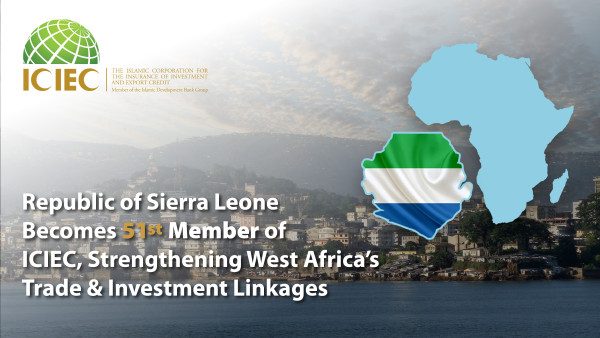

The Islamic Corporation for the Insurance of Investment and Export Credit (ICIEC) (http://ICIEC.IsDB.org), a Shariah-based multilateral insurer and member of the Islamic Development Bank Group, is pleased to announce the accession of the Republic of Sierra Leone as its 51st Member Country.
This milestone marks ICIEC's expanding presence in Sub-Saharan Africa and underscores Sierra Leone's commitment to strengthening its trade and investment partnerships through multilateral cooperation. As a Member, Sierra Leone will gain access to ICIEC's Shariah-compliant insurance and reinsurance solutions designed to facilitate exports, attract foreign direct investment, and mitigate political and commercial risks.
Welcoming Sierra Leone's membership, Dr. Khalid Khalafalla, Chief Executive Officer of ICIEC, stated: “We are delighted to welcome the Republic of Sierra Leone into the ICIEC membership. This accession reflects both the growing recognition of ICIEC's developmental mandate and Sierra Leone's vision to build a more resilient and diversified economy. We look forward to supporting the country in mobilizing investments, enhancing export competitiveness, and creating new opportunities for its public and private sectors.”
With Sierra Leone's membership, ICIEC now counts 51 Member Countries reinforcing its role as a leading multilateral provider of Shariah-compliant insurance and risk-mitigation solutions in support of the Organization of Islamic Cooperation (OIC) economies.
Distributed by APO Group on behalf of Islamic Corporation for the Insurance of Investment and Export Credit (ICIEC).Email:
ICIEC-Communication@isdb.org
Follow us on:
X: https://apo-opa.co/4a8FIyW
Facebook: https://apo-opa.co/4rfk5Dc
LinkedIn: https://apo-opa.co/3LPeBz5
YouTube: https://apo-opa.co/488lmop
Instagram: https://apo-opa.co/48vwKdT
About The Islamic Corporation for the Insurance of Investment and Export Credit (ICIEC):
As a member of the Islamic Development Bank (IsDB) Group, ICIEC commenced operations in 1994 to strengthen economic relations between OIC Member States and promote intra-OIC trade and investments by providing risk mitigation tools and financial solutions. The Corporation is the only Islamic multilateral insurer in the world. It has led from the front to deliver a comprehensive suite of solutions to counterparts in its 50 Member States. ICIEC, for the 18th consecutive year, maintained an "Aa3" insurance financial strength credit rating from Moody's, ranking the Corporation among the top of the Credit and Political Risk Insurance (CPRI) industry. Additionally, S&P has reaffirmed 'ICIEC's "AA-"long-term Issuer Credit and Financial Strength Rating for the second year with a stable outlook. ICIEC's resilience is underpinned by its sound underwriting, global reinsurance network, and strong risk management policies. Cumulatively, ICIEC has insured more than USD 121 billion in trade and investment. ICIEC activities are directed to several sectors—energy, manufacturing, infrastructure, healthcare, and agriculture.
For more information, Visit http://ICIEC.IsDB.org
Sierra Leone’s President Bio Chairs United Nations (UN) Security Council Debate, Calls Starvation a “Crime” and Food Security a Global Peace Imperative
Download logo
His Excellency Dr. Julius Maada Bio, President of the Republic of Sierra Leone and Chair of the ECOWAS Authority, today presided over a high-level United Nations Security Council open debate on “Threats to International Peace and Security: Conflict-Related Food Insecurity” at the UN Headquarters in New York.
Addressing the Council for the second time in two years during Sierra Leone's tenure, President Bio warned that hunger is increasingly being used as a weapon of war and called for stronger global action to prevent the deliberate starvation of civilians. He stressed that such acts are prohibited under international law and constitute war crimes.
The President highlighted that conflicts across regions—from Gaza and Sudan to Haiti, Ukraine, and the Sahel, continue to devastate food systems, destroy livelihoods, and deepen humanitarian crises. He described starvation as a “slow, silent, corrosive” form of violence that fuels instability, displacement, and renewed conflict.
President Bio outlined three core messages saying starvation is not collateral damage but a crime; food insecurity is both a driver of conflict and a peacebuilding imperative; and sustainable peace requires investment in agricultural resilience, markets, and human capital, especially women and youth.
He presented Sierra Leone's Feed Salone Initiative as a national model demonstrating that food security is integral to the peace and development nexus. The four-pillar programme, production, resilience, markets and value chains, and human capital, aims to strengthen productivity, reduce import dependence, and build climate-smart systems that secure stable livelihoods.
At the regional level, President Bio emphasized ECOWAS efforts to integrate food security into peacebuilding, early warning, and trade frameworks, including the expansion of the ECOWAS Food Security Reserve and the ECOWARN early warning network.
Proposing six concrete global actions, the President urged the Council to protect food systems in conflict zones, institutionalize early-warning mechanisms, safeguard humanitarian access, advance accountability for starvation crimes, link peacebuilding finance to agriculture and livelihoods, and prioritize the empowerment of women and youth across agricultural value chains.
He affirmed that Africa does not seek sympathy but partnership, noting that the continent holds the majority of the world's uncultivated arable land and significant youth-driven innovative potential. Preventing future wars, he stressed, requires treating food security as central to peace and security rather than a secondary humanitarian concern.
President Bio concluded by calling on the global community to “ensure that no child is starved into submission, no harvest held hostage, and no community driven to violence by hunger,” urging nations to align moral conscience with international law and collective action.
Distributed by APO Group on behalf of State House Sierra Leone.