
Explore more Articles in
Mali
New International Rescue Committee (IRC) data shows thousands of women and girls at risk as aid cuts cripple gender-based violence services in West Africa

Download logo
Across Burkina Faso, Mali, Niger and Nigeria, over 55% of gender-based violence (GBV) survivors supported in early 2025, have been left without continued access to essential, safe and confidential services for their recovery following broad funding cuts.
In Menaka, Mali, nearly 90% of survivors' cases are still waiting for full support.
In Burkina Faso, 52% of GBV cases remain unaddressed in the Sahel and North regions, with over 500 women and girls at risk of losing access to dignity kits, awareness sessions, and case management at the time of analysis.
In Nigeria, between 42% and 67% of GBV cases remain “open” following program closures across Borno, Adamawa, Katsina, and Zamfara States, leaving hundreds of women and girls without access to critical support.
In Niger, 26% of GBV cases in Diffa and Tillabéri are no longer being actively managed. In Balayera, IRC was the only actor providing protection services.
More than half of all survivors of gender-based violence (GBV) have lost access to critical support services following the initial complete suspension of essential funding in Niger, Burkina Faso, Mali, and Nigeria, according to data collected by the International Rescue Committee (IRC). As the protection gap widens, which leaves women and girls increasingly vulnerable to violence, isolation, and long-term harm, the IRC urges the international community of donor governments to significantly increase funding for organizations responding to GBV.
The abrupt suspension of case management, which came after large funding cuts in the first half of the year, deprived survivors of a vital service that had supported them from the moment they disclosed violence. Many had been accessing safe spaces where they could speak freely and receive life-saving medical care, psychosocial support, and legal assistance. Suddenly, survivors, many still grappling with ongoing trauma or threats, were left without anywhere to turn, their recovery interrupted, their choices curtailed, and their needs unmet.
Services shut down entirely for three to five months, depending on the country. Now, even as some programs have been brought back to partial operation, fewer than 55% of specialized GBV caseworkers have been rehired, meaning there is now limited coverage of GBV services in those locations.
Safiatou,* who lost access to IRC services for women at risk in eastern Mali, said:
“With the end of the project, I feel isolated. I keep my problems to myself because this project was special. It always gave us the opportunity to share our fears and concerns through listening sessions and awareness activities that addressed the challenges we face. The staff always responded to our concerns: they were like doctors to us girls.”
Yolande Longang, Women's Protection and Empowerment Technical Advisor for IRC in West Africa, said:
“When services were shut down, survivors were left in the dark. With urgent medical care and emotional support disrupted, survivors were left to endure their trauma in isolation. In contexts where access to comprehensive protection services including health, psychosocial, legal, and community-based support is largely limited or unavailable, their suffering remained invisible and unaddressed.
And when services finally resumed, in some locations, they were a shadow of what was needed. Even GBV case management was only partially restored, and support was limited to the most critical cases, those involving clinical management of sexual assault or imminent risk to life. This left countless survivors without the help they urgently needed, including girls at risk of child marriage and women experiencing intimate partner violence.”
GBV frontline workers were confronted with cases where survivors accessed services with significant delays; this is particularly troubling in cases of sexual assault, with GBV responders unable to provide the essential care within the critical 72-hour window following the assault. In regions where the IRC was the primary or sole provider of GBV services, the suspension has left a dangerous vacuum. With limited coverage and resources from alternative actors, many communities now rely on under-resourced local mechanisms that struggle to meet the demand for essential GBV support.
As humanitarian actors face severe funding cuts, administrative barriers, and security constraints, many open cases are left without follow-up care. Community-based organizations, though trained, lack the resources to fully assume service delivery, and government structures are too under-resourced to absorb the growing caseload.
Without urgent action to restore funding or mobilize alternative support, hard-won gains - from having appropriate levels of staffing to respond to GBV to working with communities to see GBV as a rights violation and women and girls as equal actors - risk being reversed. Operating within a broader ecosystem of humanitarian services, continued reductions in foreign aid are placing unprecedented strain on local organizations and decentralized systems already operating at their limits.
Urgent and sustained funding is essential to support GBV response organizations, including local organizations, to help close the widening gap in resources needed to protect women and girls. At the same time, it is essential to strengthen local structures and systems that provide vital support to survivors. In this world of hyper-prioritization in humanitarian response, we remind all actors that GBV prevention and response are lifesaving services and must be included in all response plans.
Distributed by APO Group on behalf of International Rescue Committee (IRC) .SYNTHETIC REPORT – Pacis TV’s Participation in the Meeting of Catholic Television Directors of Africa and Madagascar
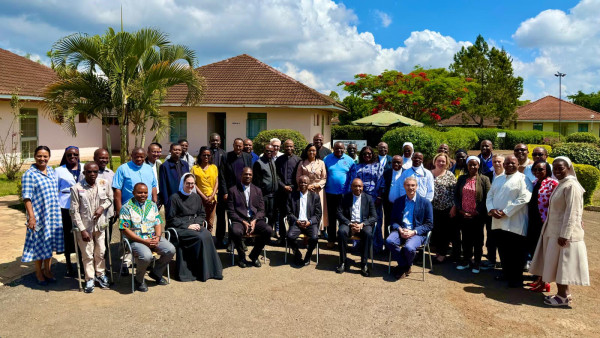
The continental meeting of Catholic Television Directors from Africa and Madagascar was held in Nairobi (Kenya) from 24 to 28 November 2025, with the participation of German partners and the Vatican Dicastery for Communication, represented by Sr. Nina, Communication Specialist.
Pacis TV had the honor of presenting:
- its recent achievements,
- its strategic projects,
- its continental and international collaboration opportunities.
- The channel also led some key segments of the meeting.
The opening session was delivered, on behalf of His Eminence Fridolin Cardinal Ambongo, by His Excellency Bishop Bernardine Mfumbusa, who was recently mandated in Kigali by the African bishops to coordinate communication within SECAM.
Participating countries: Ethiopia, Tanzania, Malawi, Zambia, Uganda, South Sudan, Kenya (AMECEA), Mali, Rwanda, Mozambique, Madagascar, Togo, Cameroon, Congo, Côte d'Ivoire, Burkina Faso, Nigeria, Germany, Argentina, Rome, and Austria.
Throughout the day, the Dicastery for Communication, Bishop Mfumbusa, and the CRTN/ACN team presented the Catholic Television Network Service for Africa Project, emphasizing:
- the urgent need to train communication experts within dioceses;
- the importance of avoiding competition with secular media;
- the mission of enlightening society through the power of truth;
- the need to strengthen collaboration with Catholic celebrities and influencers for the common good.
Special Participation of Rwandan Priests Studying at CUEA
Three Rwandan priests studying at the Catholic University of Eastern Africa received special permission to attend Pacis TV's presentation:
Fr. Patrice,
Fr. Jean de Dieu,
Fr. Damien Kimenyi.
They expressed great interest in the vision and orientations presented, thereby strengthening the link between academic formation and the Church's media mission.
SIGNIS International Update
SIGNIS also provided an update on the upcoming Kigali International Meeting scheduled for August 2026. This future gathering will prioritize:
- strengthening the digital media presence of Catholic institutions;
- developing artificial intelligence tools and influencer databases;
- addressing the communication gaps that persist in several episcopal conferences, some of which still lack official spokespersons.
Recognition of Pacis TV's Continental Leadership
After the exchanges among all African Catholic televisions, it became evident that Pacis TV stands among the leading Catholic TV stations on the continent. This recognition was strongly echoed by Mr. Nicolas Pompigne-Mognard, CEO of APO Group, who highlighted the channel's growing visibility, operational professionalism, and strategic impact across Africa.
Pacis TV is pleased to contribute actively to a renewed vision of Catholic communication in Africa, rooted in truth, collaboration, and service to the common good.
Distributed by APO Group on behalf of Pacis TV.African Influencers Unite at the African Union to Reclaim the Narrative on 141 Years Since the Berlin Conference

Marking 141 years since the Berlin Conference, a dark day when Africa's soul was fragmented, African influencers, Journalists, Content Creators, Artists, Cultural Custodians, Activists, and Policymakers gathered at the African Union Headquarters for the High-Level Influencers Forum on Borderless Africa. The forum, held on 14 and 15 November 2025, paid a powerful homage to the resilient spirit of our forefathers and matriarchs who resisted colonial division and imposed borders.
Download Document: https://apo-opa.co/4o5by2S
In a historic assembly at the African Union building, these voices converged to rewrite Africa's story and champion a future of African unity and regional integration. This was not just a convening, it was a space to reclaim our identity as Africans, undo the artificial borders, claim the urgency as Africans and renew our commitments towards a borderless Africa.
H.E. Amb. Fred Ngoga, Senior Advisor for International Partnerships at the African Union Commission, in his keynote speech, mentioned: "Integration is more than policy; it is about people experiencing freedom across their own continent. Influencers have the power to make this real for millions of Africans."
Hardi Yakubu, Coordinator of Africans Rising Movement, challenged the continent to move beyond historic grievances: "We can no longer complain about what the Berlin conference did 141 years ago, yet we have the power to undo what 13 men sat down to do. We are asking for things that we shouldn't even be asking for. We must begin to localise the borderless campaign."
He further highlighted the burden of colonial legacy, saying, "We no longer want to accept the situation 141 years after the Berlin conference, that African people have to pay dollars to come to Ethiopia, which is the headquarters of the African Union."
Armed with their phones, cameras and pens, 36 influencers, journalists and artists representing all regions of Africa, including the diaspora, united in boldly signing the Addis Ababa Influencers Declaration on Borderless Africa to H.E. Amb Robert Afriyie, Ghana's Ambassador to Ethiopia and Permanent Representative to the African Union Commission. The Ambassador received the declaration with resolute encouragement: “Difficulty is not impossibility. Reparations remind us that justice is hard, but never out of reach."
He urged the influencers to wield the power of technology wisely, reminding them, "The device in your hand once filled an entire room. Use it wisely. Search nonsense, and the algorithm will feed you nonsense. History is not a marathon but a relay. Run your leg with purpose, then pass the baton to the next generation."
Ambassador Afriyie underscored the importance of ownership in storytelling, stating, “Africa must tell its own stories through its own lenses. When we own the narrative, we reclaim our power."
Further strengthening this momentum, the creation of the Borderless Africa Fund was announced to promote and support advocacy, awareness campaigns, and Borderless Africa initiatives across the continent, providing crucial resources to the movement.
The committed storytellers, influencers, and journalists vowed to honour the declaration by shaping the African narrative with dignity, rejecting stereotypes, sensationalism, and fear-mongering. They pledged to use their platforms to highlight African achievements, expose injustices hindering freedom of movement, and engage governments and regional bodies with factual, people-centred advocacy.
"Africa has the diversity and creativity to populate millions of new worlds. Yet, our full potential remains unrealised, waiting for us to manifest it," said Rocky Dawuni, Grammy-nominated Ghanaian musician and humanitarian.
Their vision for a borderless Africa is bold: a continent where every citizen can move, live, and dream freely; where the African passport is universally accepted with visa-free travel guaranteed, air travel is affordable, and intra-African trade thrives. Governments are called upon to embrace integration as the foundation for peace, prosperity, and dignity.
Despite progress, challenges remain. As of 2025, only 32 of the 55 African Union member states have signed the 2018 AU Protocol on Free Movement Protocol on Free Movement of Persons, and a mere four countries, Rwanda, Niger, Mali, and São Tomé and Príncipe, have ratified it. The forum's united front sends a strong message that this must change.
The two-day High-Level Influencers Forum on Borderless Africa was more than a dialogue; it planted a lasting mark within the African Union, echoing the dream of unity and belonging. It is indeed a reflection of the commitment of the Africans Rising Movement towards free movement in Africa through its flagship campaign, Borderless Africa, and a resounding reassurance of reclaiming the right to movement as a key justice discourse.
To support this vision and help make a borderless Africa a reality, join us by signing the petition available on our website: https://www.AfricansRising.org/
Distributed by APO Group on behalf of Africans Rising.For more information, contact:
campaigns@africans-rising.org
Media Contact:
Joyce@crescendodigital.co.uk
About Africans Rising:
Africans Rising is a Pan-African movement of movements, uniting individuals, communities, and organisations across Africa and the diaspora to advance social justice, human rights, and continental solidarity. The movement amplifies African voices, champions campaigns on issues like reparations, free movement, and gender equality, and empowers citizens to shape policies, narratives, and creative initiatives that drive Africa's transformation. Through advocacy, storytelling, and grassroots mobilisation, Africans Rising works to ensure that the continent and its people reclaim agency over their future.
30th Conference of the Parties (COP30): The African Development Bank Highlights the essential role of climate finance for conflict-affected countries

The African Development Bank Group (www.AfDB.org) is playing a key role in supporting conflict-affected countries facing climate disruptions, Bank officials emphasised during a COP30 panel discussion on 12 November in Belém.
Through its Climate Action Window, established in 2022, the Bank Group has supported 41 projects worth $322 million and mobilised an additional $1.6 billion in co-financing, while building an adaptation pipeline of nearly $2 billion, according to Kevin Kariuki, Bank Vice-President for Power, Energy, Climate and Green Growth.
Kariuki spoke during "Bridging the Gap: Making Climate Finance Work for the Underserved," a side event co-organised by ODI Global and the United Nations Climate Security Mechanism.
"We must ensure that climate finance benefits the most underserved populations, especially those living in areas where security crises overlap with climate distress," said Rebecca Nadin, Director of Global Risks and Resilience at ODI Global.
The session brought together leaders from climate finance institutions, government representatives, and multilateral development agencies to explore ways to scale up climate finance for countries most vulnerable to climate change, particularly those affected by conflict.
Oumar Gadji Soumaila, Director General of Chad's Special Environmental Fund, stressed that "climate investments in conflict-affected areas are often the only support they receive, hence their essential nature." He pointed to communities around Lake Chad where climate financing has been vital for survival amid ongoing insecurity.
The Climate Action Window, created during the African Development Fund's 16th replenishment with contributions from Germany, the United Kingdom, Netherlands, Ireland, Switzerland, and Norway, dedicates funds exclusively to low-income, fragile and climate-vulnerable countries. The African Development Fund is the concessional lending arm of the African Development Bank Group
The funding breakdown reflects these nations' urgent needs:
- 75% allocated to adaptation projects
- 15% to mitigation efforts
- 10% to technical assistance
- 64% of adaptation financing provided as grants
Several African nations are advancing climate-security policies. Burkina Faso has already adopted a national framework, while the Liptako-Gourma Authority (https://LiptakoGourma.org)—bringing together Burkina Faso, Mali and Niger—plans to adopt a regional policy by end-2026.
New Momentum at COP30
The Belém discussions generated fresh political momentum. Mauritania announced its intention to join the climate security platform, and Germany, Italy, Croatia and other countries pledged new contributions to the United Nations Climate Security Mechanism to help nations facing both security and climate crises.
The event highlighted opportunities for collective action to make climate finance more accessible and effective in fragile contexts, emphasising national platforms as central mechanisms for delivering support.
The CSM is a joint UN initiative involving departments of Political and Peacebuilding Affairs, the United Nations Development Programme, the United Nations Environment Programme, and Peace Operations, that is working to analyze climate-security links and develop response strategies.
Distributed by APO Group on behalf of African Development Bank Group (AfDB).